
Working in the shopping cart migration sphere for over a decade, Cart2Cart has unique possibility to monitor tastes of the current online shop owners, and, today, we’ve decided to share this useful knowledge with you. For a smoother transition, consider our Universal eCommerce Migration Checklist. So, which shopping platforms merchants choose to migrate to in most cases? Which solutions have often failed users expectations, disposing them to e-Commerce re-platforming? Are hosted or open-source carts ruling the market nowadays? Here, you’ll find the data driven answers to these and other curious, market related questions.
We have we’ve prepared a descriptive white paper, that graphically illustrates the answers to the uplisted questions, and the main goal of the following article - is to give you a preview of it.
Thus, where did e-merchants migrate to the most frequently?
Many people, when thinking of shopping carts, often consider leading platforms like Shopify or WooCommerce. Having gathered our in-house statistics, we've observed that these platforms, along with others such as Magento and PrestaShop, consistently rank among the top choices for merchants looking to re-platform.
Our data shows a diverse range of top destinations for migrations, reflecting current market preferences:
- Major hosted platforms (e.g., Shopify, BigCommerce)
- Popular open-source solutions (e.g., Magento, PrestaShop)
- Other emerging platforms and specialized solutions
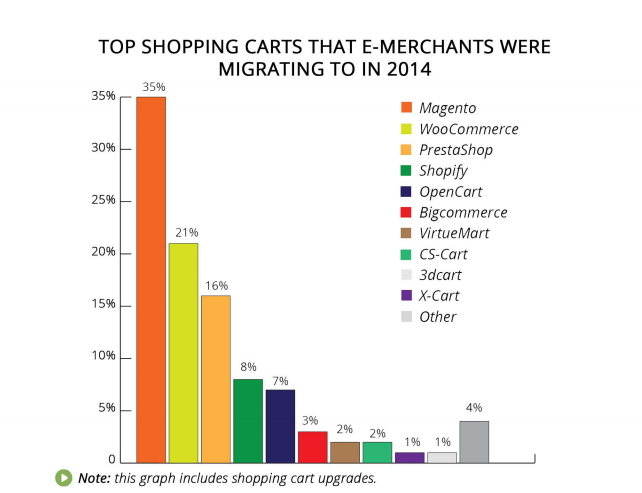
Shopify and BigCommerce now stand as major contenders, with OpenCart also maintaining a consistent presence among our users. Meanwhile, other e-Commerce solutions continue to find their niche in the evolving market.
Which shopping carts online shop owners were trying to escape?
Reflecting the dynamic nature of the e-Commerce landscape, platforms that are frequently chosen as destinations also see significant migrations from them. This often happens due to merchants upgrading to newer versions (for example, refer to our Magento 1 to Magento 2 Migration Guide) or seeking different functionalities. For instance, platforms like Magento, known for their powerful features, also see migrations as users upgrade to newer versions or move to other robust solutions. Here are common platforms e-merchants have been migrating from:
- Leading open-source platforms (e.g., Magento, PrestaShop)
- Specialized carts and older versions (e.g., VirtueMart)
- Other widely used e-Commerce solutions
Check our white paper for a more detailed information.
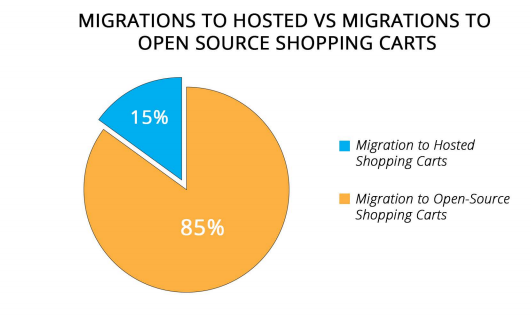
Hosted against open-source. Which type of e-Commerce platforms is dominating the market?
We have all heard about the evolving dynamics between open-source and hosted solutions. While open-source platforms continue to offer deep customization and control, the market has seen a significant shift towards hosted solutions, favored for their ease of use and managed infrastructure.
Our current data shows a strong preference for platforms that balance flexibility with simplified management. Migrations to hosted solutions now frequently represent a significant portion of our total transfers, reflecting a broader industry trend towards streamlined and scalable e-Commerce environments.
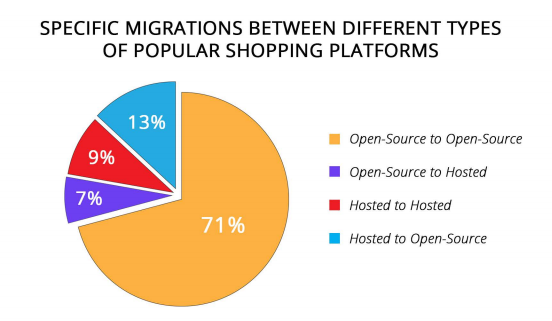
Platform migrations continue to evolve, with movements between various types of solutions. Transfers to robust CMS platforms with integrated e-Commerce functionalities are also increasingly popular, making up a growing segment of overall migrations.
Since e-Commerce market is extremely unsteady and its leaders are getting displaced more often than kings in “Game of Thrones”, e-merchants often find it difficult to monitor the market situation. Therefore, we hope that these insights into migration trends will clear things out for you, at least a bit, and help you make deliberated market decisions in the future.
However if you’d like to get a more detailed information that includes top migration trends of recent years, descriptive data about transfers from Magento Go and ProStores, and even specialized needs like Database Dump Migration - download our illustrative white paper. Being absolutely free, it’ll provide you with broad, useful stats and ensure that you truly get a grasp on the current e-Commerce market.
P.S Despite the fact that Cart2Cart has partner relations with a number of popular shopping carts, this article, as well as the white paper, is by no means promoting them. Our only purpose here - is to present an unbiased statistics, that can be helpful to an e-Commerce community.
Monthly Update – December 2025
As we close out 2025, the e-commerce sector is increasingly shaped by advancements in AI and automation. Retailers are now focusing on hyper-efficient operations and predictive analytics to stay ahead. Key trends for this month include the widespread adoption of AI-powered inventory management systems, which optimize stock levels and reduce waste, and automated customer service solutions, providing instant support and enhancing satisfaction without extensive human intervention.
Furthermore, December 2025 highlights a strong emphasis on headless commerce architectures. Businesses are decoupling their front-end and back-end systems to offer unparalleled flexibility and speed in deploying new customer experiences across multiple touchpoints, from web and mobile apps to IoT devices. This approach facilitates rapid innovation and allows for highly customized user journeys. Data privacy also remains a paramount concern, with new regulations and technologies emerging to give consumers greater control over their information, necessitating robust compliance strategies for all e-commerce platforms.
For those planning migrations, selecting a platform that supports a modular, API-first approach will be crucial for future scalability and adaptability. Integrating advanced AI and ensuring data security should be at the forefront of any re-platforming strategy as we head into the new year.
For more details, explore our FAQ section or schedule a call with a migration expert.