
Recent in-house research indicates that a significant majority of Cart2Cart migrations are performed to open source platforms, reflecting their sustained popularity.
The dominance of open source solutions seems counterintuitive, since people generally hate complexity, but the fact remains that open source carts are ahead of hosted ones, taking comfortable market position. At least for now.
So, what makes them great, which self-hosted platforms are in the lead, and should they be afraid of the sneaky competitors - SaaS solutions and eCommerce plugins?
Today we’ll try to answer these and other e-Commerce related questions. Dig in!
Firstly - who’s the king?
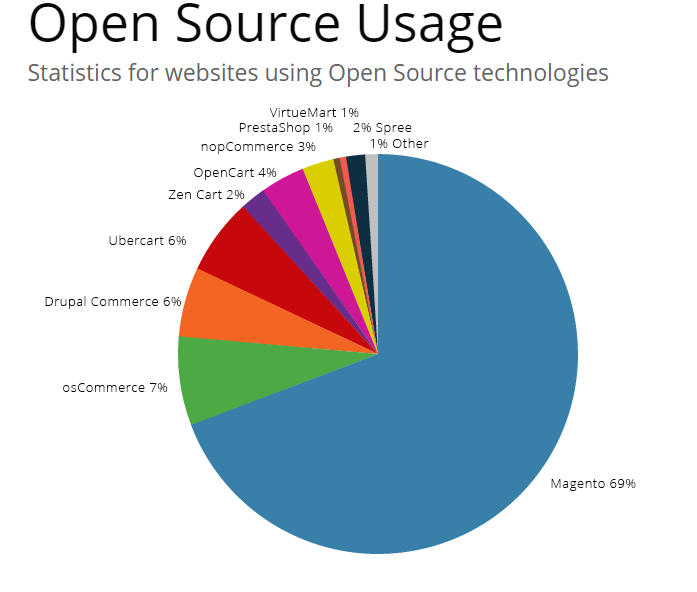
No secret here - Magento continues to be a leading platform among open source admirers, according to BuiltWith. Migrating data to Magento is a frequent request at Cart2Cart, among our numerous supported carts. As experience shows, our clients are most likely to perform such transfers: Magento to Magento (upgrade); WooCommerce to Magento; OpenCart to Magento.
 [quiz-cat id="679485"]
Why is it so?
[quiz-cat id="679485"]
Why is it so?
The thing to understand - Magento is more than just a shopping cart. It’s an e-Commerce cult. People take classes on its management and development, merchants attend “Meet Magento” presentations in different parts of the world, like they’re rock concerts (I might be exaggerating). Each new platform’s version causes a splash when it’s released, whipping store owners into an updating frenzy.
Such vast following is generated due to the powerful features the cart provides, unlimited customization possibilities, internationalization options and, most of all, because it is truly exciting to be a member of Magento community. The platform remains a dominant force in the open source market, and, evidently, isn’t planning to give up its crown any time soon.
e-Commerce plugins - are they a threat to open source carts?
Very much so. Industry reports and market share analyses, such as those often presented by Datanyze, consistently show that WooCommerce, the popular WordPress extension, often commands a larger overall market share than Magento.
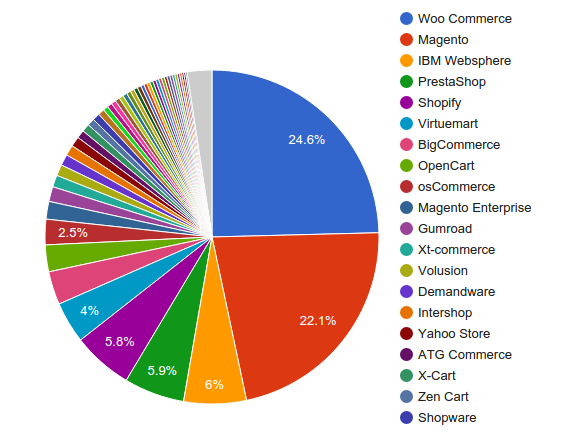
The only difference between extensions and regular open source platforms is that plugins aren’t independent, they can only be added to an existing website. Also, according to some experts, while traditionally seen as less suited for large businesses due to perceived limited functionality, its ecosystem has grown to support a wider range of enterprise needs.
WooCommerce has proved its strength within our service as well. Our recent data shows a strong and growing trend towards WooCommerce, often rivaling or surpassing migrations to Magento, indicating the continued intensity of their competition. As you can see - the rivalry is heating up.
What about hosted platforms then?
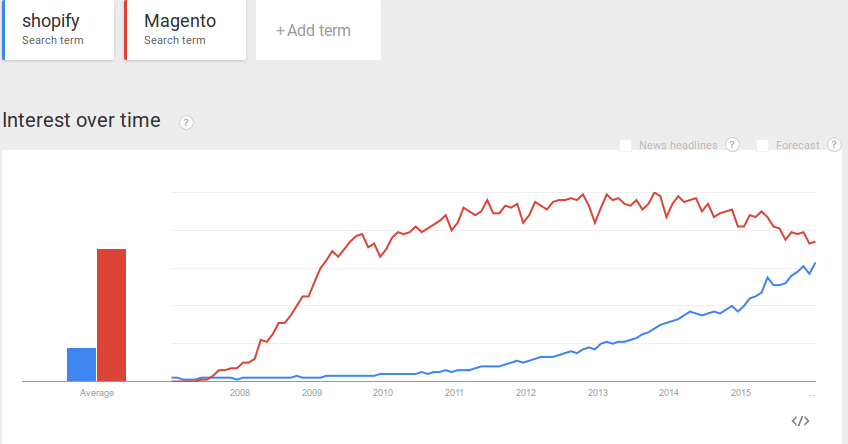
As for now, hosted platforms are still behind. Although, Shopify, the most popular of them, is already stepping on Magento’s toes, according to Google Trends
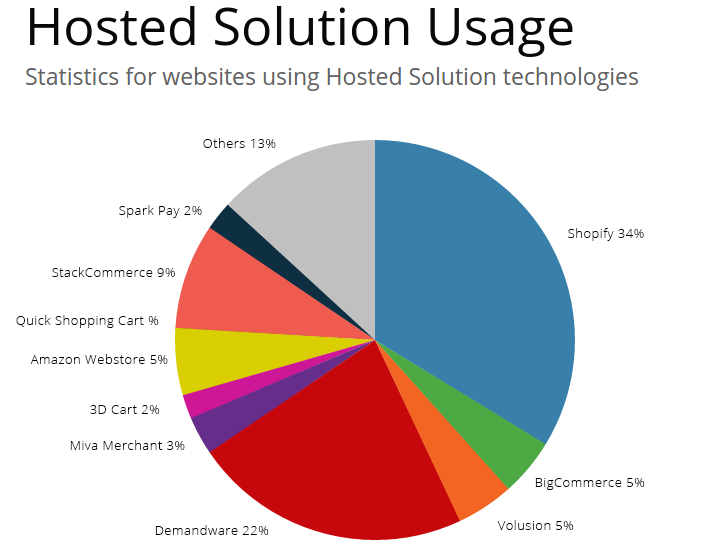
Shopify’s appeal lies in its management simplicity - the cart’s considered “best choice for new merchants” by many prominent experts - high performance speed, and reliable free support. It’s diversified features, i.e point-of-sale support, option to sell directly through social media, great SEO tools and convenient pricing system help it stand out from other hosted platforms. Currently, a substantial majority of hosted cart users choose Shopify, positioning it significantly ahead of other key competitors like BigCommerce and Salesforce Commerce Cloud (formerly Demandware).
So, why are open source carts more popular?
Limits - no matter how much functionality does a hosted cart provide initially, with growth, you’ll need more. If that happens, upgrade is the only choice, and that means a bigger monthly fee. Open source platforms, on the other hand, won’t tax or restrain your business expansion in any way.
Design - Many hosted carts provide a decent choice of design templates. Shopify, for example, stands out particularly in that regard - it offers plenty of free and paid themes that are all stylish, beautiful and customizable. Nonetheless, the rich choice is still limited. If you’re obsessed with being one of kind, which most of us are, open source carts will bring you more possibilities to stand out.
Price - Most hosted solutions require a monthly fee. It’s usually not substantial, but any obligatory payments can make you anxious in the beginning, when you’re not sure the business is going to work. Conversely, most open source carts are free to download and install.
Summing up
Hosted and self hosted carts might be compared, I guess, to TV and Netflix. When watching CBS for instance - your choice is limited - see movies and shows it’s broadcasting, switch the channel or turn off the TV. With Netflix, on the other hand, you pick which shows to see and when to see them. If you get bored - select a movie, a stand up special or a documentary - there is always an array of options available. Okay, maybe we’ve got too deep into this analogy, but you get the point - open source carts win because they provide an ultimate freedom of choice.
So, who do you think the future belongs to - open source or hosted platforms? Share your opinion with us.
Monthly Update – March 2026
In March 2026, the conversation around e-commerce architecture is increasingly dominated by headless commerce and composable platforms. This strategic shift allows businesses unprecedented flexibility, detaching the frontend (customer-facing experience) from the backend (e-commerce functionalities like product management and order processing). This decoupling enables brands to deliver highly customized, lightning-fast shopping experiences across various touchpoints—web, mobile apps, IoT devices, and even smart mirrors—without being constrained by a monolithic platform. For open-source enthusiasts, this means more freedom to integrate best-of-breed services and craft unique user interfaces, while hosted solutions are also evolving to offer more API-driven capabilities. Composable commerce, building on the headless approach, emphasizes assembling various independent, interchangeable components (like CMS, PIM, payment gateways) to create a tailored solution that precisely fits a business's needs. This agility is crucial for rapid adaptation to market changes and consumer demands. Adopting a headless or composable strategy can significantly enhance scalability, performance, and the ability to innovate, offering a competitive edge in a dynamic digital marketplace. It allows for specialized tooling in each layer, leading to optimized development cycles and a more resilient infrastructure, ensuring that retailers can quickly pivot and implement new features without a full platform overhaul.
For more details, explore our FAQ section or schedule a call with a migration expert.