

Shopify to CubeCart Migration - Step-by-Step Guide & Expert Services
Shopify to CubeCart migration made simple and secure. Ready to move Shopify store to CubeCart without data loss or downtime? Cart2Cart specializes in seamless transitions, ensuring your SEO is preserved during the switch from Shopify to CubeCart. Our automated service rapidly transfers all your vital data with unmatched security. Explore our step-by-step guides for a DIY approach to transfer data, or opt for professional assistance for a completely hands-off Shopify to CubeCart migration. Start your effortless migration journey now.
What data can be
migrated from Shopify to CubeCart
-
Products
-
Product Categories
-
Manufacturers
-
Customers
-
Orders
Estimate your Migration Cost
Thanks to Cart2Cart`s flexible pricing policy, the migration price depends on the number of transferred entities and the additional migration options you select. Simply choose your Source and Target platforms and get the approximate price of your Shopify to CubeCart store conversion right after finishing the free Demo.
How to Migrate from Shopify to CubeCart In 3 Steps?
Connect your Source & Target carts
Choose Shopify and CubeCart from the drop-down lists & provide the stores’ URLs in the corresponding fields.
Select the data to migrate & extra options
Choose the data you want to migrate to CubeCart and extra options to customise your Shopify to CubeCart migration.
Launch your Demo/Full migration
Run a free Demo to see how the Cart2Cart service works, and when happy - launch Full migration.
Migrate Shopify to CubeCart: The Ultimate 2025 Guide for Merchants
Seamlessly Transition Your E-commerce Store: Shopify to CubeCart Migration Guide
As an e-commerce merchant, you understand that your platform is the backbone of your online business. When the time comes to transition, moving from a platform like Shopify to CubeCart can open up new avenues for customization, control, and functionality. This comprehensive guide will walk you through every step of replatforming your store, ensuring a smooth and efficient data transfer with minimal downtime.
Migrating your store's essential data, including products, customer information, orders, and reviews, doesn't have to be a daunting task. With the right strategy and tools, you can ensure data integrity and maintain your SEO rankings during the move. We'll leverage an automated migration service to simplify the process, focusing on key areas like data mapping, 301 redirects, and post-migration optimization.
Why Migrate from Shopify to CubeCart?
Merchants choose to switch platforms for various reasons, including seeking more control over their store's environment, cost-efficiency, or specific features that better align with their long-term business goals. CubeCart, as a self-hosted solution, offers a high degree of flexibility and ownership, making it an attractive option for businesses looking to expand their capabilities beyond a hosted solution like Shopify.
Prerequisites for a Successful Shopify to CubeCart Migration
Before you begin the migration process, a few essential steps will ensure a smoother transition and help safeguard your valuable data. Proper preparation is key to a successful replatforming project.
- Back Up Your Shopify Store Data: Always create a full backup of your current Shopify store. This includes product data, customer lists, order history, CMS pages, and any custom code. While the migration tool protects your data, a personal backup is a critical safety net.
- Set Up Your CubeCart Store: Ensure you have a fresh installation of CubeCart on your hosting server. You'll need administrative access to this new store, including your admin login, password, and URL. Familiarize yourself with your new CubeCart environment.
- Install Necessary Plugins/Modules: For an automated migration, you will need specific connectors. For your Shopify source store, the Cart2Cart Store Migration App is required. For your CubeCart target store, you'll need the Cart2Cart CubeCart Migration module. Ensure these are installed and configured according to their instructions. CubeCart's connection relies solely on a migration bridge, which will be installed via FTP access to your CubeCart root folder. (What is a root folder and where can I find it?)
- Review Shopify Limitations: Be aware of Shopify's limitations. For example, Shopify's 'Pause and Build' plan blocks orders, and reviews often require an external app like AirReviews to be migrated. It's also recommended to disable notifications on your Shopify store during migration to avoid overwhelming customers with redundant alerts.
- Consider Data Integrity: Understand what data entities you want to move. Both platforms support products (including SKUs and variants), categories, customers, orders, and CMS pages. CubeCart also supports manufacturers, invoices, and taxes, while Shopify includes gift cards and blogs.
- Prepare Your Hosting Environment: Ensure your CubeCart hosting has sufficient resources (disk space, memory, processing power) to handle your entire catalog and customer database. A robust hosting environment minimizes the chance of migration interruptions. (Can my new hosting cause migration interruption?)
For more detailed preparation tips, refer to our guides on How to prepare a Source store for migration? and How to prepare a Target store for migration?
Performing the Migration: A Step-by-Step Guide
The migration process is streamlined into several easy-to-follow steps using an automated migration tool. Here's how to transfer your Shopify store data to CubeCart:
Step 1: Start Your Migration and Connect to the Service
Begin by initiating your migration. Most services will offer a user-friendly wizard to guide you through the process.

Step 2: Set Up Your Shopify Source Store
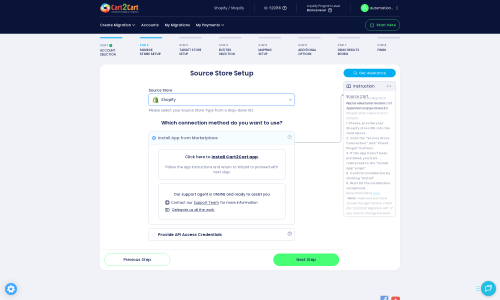
The first step in the wizard involves connecting your current Shopify store. You'll be prompted to provide your Shopify store's URL.
- Choose Connection Method: You can typically connect your Shopify store using one of two methods: installing the dedicated migration app from the Shopify App Store or providing API access credentials. Installing the app is often the most straightforward method.
- Install App from Marketplace: Click the provided link to install the Cart2Cart Store Migration App directly from the Shopify marketplace. Follow the on-screen instructions within Shopify to grant the necessary permissions. This method automatically handles the required API scopes and tokens.
- Provide API Access Credentials (Alternative): If you prefer, you can manually generate Admin API access tokens. This involves creating a custom app within your Shopify admin panel, configuring the necessary API scopes (e.g., read_products, read_customers, read_orders), and then using the generated access token to establish the connection. (The Short & Essential Guide to Access Credentials for Cart2Cart)
Step 3: Set Up Your CubeCart Target Store
Next, configure the connection to your new CubeCart store. CubeCart exclusively uses a 'bridge' connection method for data transfer.
- Provide CubeCart Details: Enter your CubeCart store's URL, along with your administrator login and password.
- Install the Migration Bridge: The system will prompt you to download a 'bridge' file. You will need to upload this file to the root folder of your CubeCart installation via FTP. This bridge acts as a secure gateway, allowing the migration tool to access your CubeCart database and perform the data transfer. Confirm the bridge location after uploading.
- Validate Connection: The tool will then validate the connection, ensuring it can securely communicate with your CubeCart store.
Step 4: Select Data Entities for Migration
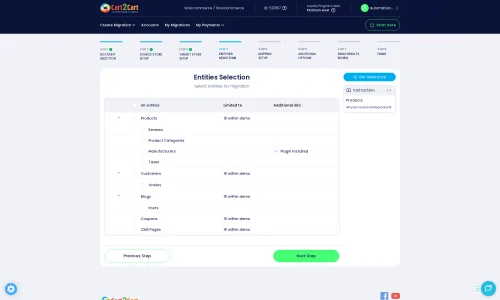
This critical step allows you to choose exactly what data you want to transfer from Shopify to CubeCart. You can select all available entities or pick specific ones based on your needs.
- Core Entities: Common selections include Products (SKUs, variants, images, descriptions), Product Categories, Customers (customer data, addresses), Orders (order IDs, statuses, purchase history), and Product Reviews.
- Additional Entities: You may also choose to migrate CMS Pages, Coupons, and any other supported data types. Carefully review the list to ensure all vital information, including metadata and link equity components, is included.
Step 5: Configure Additional Options & Data Mapping
This is where you fine-tune your migration for optimal results and data integrity.
Additional Migration Options
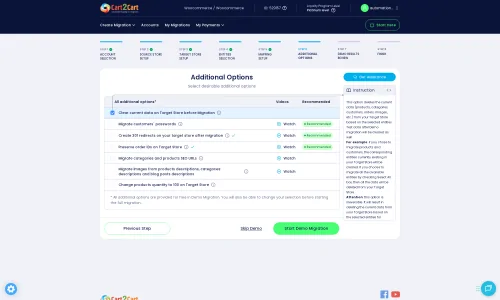
Select various checkboxes to customize the data transfer:
- Clear Target Store Data: Opt to clear current data on your CubeCart target store before migration, ensuring a clean slate.
- Preserve IDs: Choose to preserve Product IDs, Order IDs, and Customer IDs from your Shopify store, which is crucial for maintaining existing links, SEO rankings, and external integrations.
- Migrate Images in Description: Ensure product images embedded within descriptions are transferred.
- SEO URLs & 301 Redirects: Enable the creation of SEO-friendly URLs and automatic 301 SEO redirects. This helps preserve your link equity and existing SEO rankings, preventing broken links for your customers.
- Password Migration: Migrate customer passwords to ensure a seamless user experience post-migration.
- Migrate Invoices: Transfer invoice records if available and supported.
Data Mapping
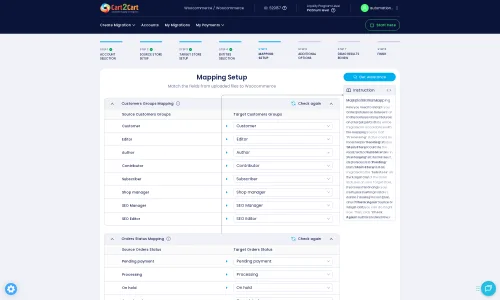
Map your Shopify customer groups and order statuses to their corresponding equivalents in CubeCart. This ensures that customer roles (e.g., 'Customer', 'Wholesale') and order states (e.g., 'Pending', 'Processing', 'Completed') are correctly translated and maintained on your new platform, preserving crucial customer data and operational workflows.
Step 6: Run Free Demo & Full Migration
Before committing to the full migration, it's highly recommended to perform a free demo migration.
- Free Demo Migration: This trial run transfers a limited number of entities (e.g., 10-20 products, customers, orders) to your CubeCart store. It allows you to review the data transfer quality, check data integrity, and ensure everything appears as expected. It's a vital step to identify and address any potential issues early.
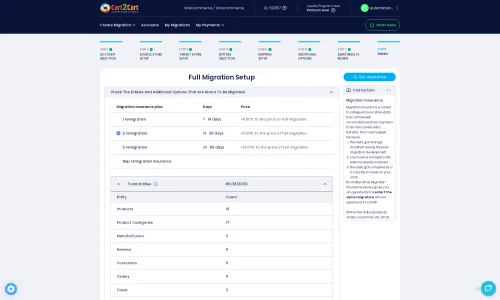
- Full Migration: Once you're satisfied with the demo results, proceed with the full migration. This will transfer all selected data entities from your Shopify store to CubeCart. During this phase, aim for minimal downtime by planning the migration during off-peak hours. You can also opt for a Migration Insurance Plan, which provides a set number of remigrations for a specified duration, offering peace of mind. (How Migration Insurance works?)
Post-Migration Steps
Once your data has successfully moved to CubeCart, there are crucial post-migration tasks to complete to ensure your new store is fully operational and optimized.
- Review Migrated Data: Thoroughly check all migrated products, categories, customer accounts, and orders. Verify product SKUs, descriptions, images, pricing, and variant options. Ensure customer passwords work, and order histories are accurate.
- Configure DNS Settings: Update your domain's DNS settings to point to your new CubeCart store. This is when your new store goes live.
- Implement 301 Redirects: If you didn't use the automated 301 redirect option during migration, or if you have custom URLs, manually set up 301 redirects from your old Shopify URLs to the new CubeCart URLs. This is essential for SEO rankings, maintaining link equity, and ensuring a smooth user experience.
- Install and Configure CubeCart Extensions: Install any necessary CubeCart modules or themes to enhance functionality and appearance. Reconfigure payment gateways, shipping methods, and any third-party integrations (e.g., analytics, email marketing, ERP systems).
- Update Internal Links: Scan your new CubeCart site for any internal links that might still point to old Shopify URLs and update them.
- SEO Check: Review your new CubeCart store's meta titles, descriptions, and canonical tags. Submit your new sitemap to search engines (Google Search Console, Bing Webmaster Tools) to help them re-index your site.
- Conduct Thorough Testing: Perform extensive testing of your CubeCart store. This includes:
- Browsing products and categories.
- Adding items to the cart and completing the checkout process.
- Creating new customer accounts and logging into existing migrated accounts.
- Testing all forms, search functionality, and filtering options.
- Verifying email notifications (order confirmations, shipping updates).
- Remove Shopify Store: Once you are fully confident that your CubeCart store is operating perfectly, you can consider closing your Shopify account.
A successful e-commerce replatforming project requires careful planning, execution, and post-migration validation. By following these steps, you can confidently transition your online business from Shopify to CubeCart, leveraging the robust features and control that your new platform offers.
Should you require any assistance or wish to explore migration customization options, feel free to contact our experts.
Ways to perform migration from Shopify to CubeCart
Automated migration
Just set up the migration and choose the entities to move – the service will do the rest.
Try It Free
Data Migration Service Package
Delegate the job to the highly-skilled migration experts and get the job done.
Choose Package

Benefits for Store Owners

Benefits for Ecommerce Agencies
Choose all the extra migration options and get 40% off their total Price

The design and store functionality transfer is impossible due to Shopify to CubeCart limitations. However, you can recreate it with the help of a 3rd-party developer.

Your data is safely locked with Cart2Cart
We built in many security measures so you can safely migrate from Shopify to CubeCart. Check out our Security Policy
Server Security
All migrations are performed on a secure dedicated Hetzner server with restricted physical access.Application Security
HTTPS protocol and 128-bit SSL encryption are used to protect the data being exchanged.Network Security
The most up-to-date network architecture schema, firewall and access restrictions protect our system from electronic attacks.Data Access Control
Employee access to customer migration data is restricted, logged and audited.Frequently Asked Questions
Will my Shopify store experience downtime during migration to CubeCart?
Can customer passwords be migrated when switching from Shopify to CubeCart?
Should I use an automated tool or hire an expert for Shopify to CubeCart migration?
Is my data secure during the Shopify to CubeCart migration process?
Is it possible to transfer my Shopify store design/theme to CubeCart?
How long does it take to migrate an online store from Shopify to CubeCart?
What data entities can be migrated from Shopify to CubeCart?
What factors influence the cost of migrating from Shopify to CubeCart?
How can I prevent losing SEO rankings when migrating from Shopify to CubeCart?
How can I verify data accuracy after migrating from Shopify to CubeCart?
Why 150.000+ customers all over the globe have chosen Cart2Cart?
100% non-techie friendly
Cart2Cart is recommended by Shopify, WooCommerce, Wix, OpenCart, PrestaShop and other top ecommerce platforms.
Keep selling while migrating
The process of data transfer has no effect on the migrated store. At all.
24/7 live support
Get every bit of help right when you need it. Our live chat experts will eagerly guide you through the entire migration process.
Lightning fast migration
Just a few hours - and all your store data is moved to its new home.
Open to the customers’ needs
We’re ready to help import data from database dump, csv. file, a rare shopping cart etc.
Recommended by industry leaders
Cart2Cart is recommended by Shopify, WooCommerce, Wix, OpenCart, PrestaShop and other top ecommerce platforms.
Trusted by eCommerce dominators since 2009












Very impressed with cart2cart. We used it to migrate userbase and productbase from OsCommerce to Cubecart. Excellent support – even when dealing with a database issue in one of the carts, not really to do with cart2cart! I would recommend.
Review source
Migration from Shopify to BigCommerce was exactly what I need it. Customers information, orders, products description and images were displayed in my new platform perfectly. Additionally, the support team were very helpful and patience while I was doing all of this process. I highly recommend it!
Review source
So now I have a perfect copy of my Shopify store on my Woocommerce platform. All within 2 days and I didn’t have to code anything – the migration took just a few clicks – fully automated. Ok, that’s it I just like when I see somebody really care about your business so I felt like I’d let the world know about my experience with this company
Review source
Excellent Support for the non expert who needs a lot of assistance they spent as much time as I needed to insure I got my migration. The upload went well after the Demo. Customer service was there when I had questions or issues to fine tune after purchase. I would recommend if you need to import / migrate your Products from Shopify to Woocommerce in Word Press as I did.
Review source
Just tried a Demo migration for Cart2Cart to migrate the shop of a Shopify website into a WordPress site with WooCommerce enabled. I did have a small technical snag when setting up the Connection Bridge, however Tech Support was on the spot with quick service and even did a little dirty work for me.
So far, so great.
Review source
I used this tool with one of my clients recently as they desired to make the move from Shopify to WooCommerce. Cart2Cart’s migration service provided perfect for this purpose. Their customer support is always ready to help via live chat too. Highly recommend this service for data migration from Shopify to WooCommerce.
Review source
I found out about Cart2Cart when I decided it was time to transition from Shopify to Woocommerce. They have been very helpful with all my technical questions and have been quick to respond when I need assistance. Highly recommended!
Review source
I tried the Cart2Cart demo for Shopify to WordPress migration and was really impressed! Great tool for migrations
Review source
Migrating from shopify to woocommerce was easy and support was very helpful and responsive. would use again in a heartbeat.
Review source