

Basekit to CubeCart Migration - Step-by-Step Guide & Expert Services
Embarking on a Basekit to CubeCart migration? Cart2Cart streamlines your journey to move Basekit store to CubeCart. Our service ensures a fast, secure, and SEO-preserving switch from Basekit to CubeCart, guaranteeing zero downtime. Whether you prefer a comprehensive step-by-step guide to seamlessly transfer data yourself, or require our experts to manage your entire Basekit to CubeCart migration, we provide the perfect solution. Start your hassle-free transfer now.
What data can be
migrated from Basekit to CubeCart
-
Products
-
Product Categories
-
Manufacturers
-
Customers
-
Orders
- Name, ID, SKU, Short Description, Full Description, Manufacturer, Tax Class, Sort Order.
- MSRP.
- Meta Title, Meta Keywords, Meta Description.
- Quantity, Stock Availability.
- Weight.
- Options(Name, Price).
- Name, ID, Status.
- Meta Title, Meta Description, Meta Keywords.
- Name, Meta Title.
- ID, Telephone, Newsletter, Gender, Created Date.
- Customer Billing Address.
- Customer Shipping Address.
- ID, Order Date, Order Status, SubTotal Price, Discount Price, Tax Price, Shipping Price, Total Price.
- Customer Name, Email, Telephone, Billing Address.
- Shipping Address.
- Name, ID, SKU, Short Description, Full Description, Manufacturer, Tax Class, Sort Order.
- MSRP.
- Meta Title, Meta Keywords, Meta Description.
- Quantity, Stock Availability.
- Weight.
- Options(Name, Price).
- Name, ID, Status.
- Meta Title, Meta Description, Meta Keywords.
- Name, Meta Title.
- ID, Telephone, Newsletter, Gender, Created Date.
- Customer Billing Address.
- Customer Shipping Address.
- ID, Order Date, Order Status, SubTotal Price, Discount Price, Tax Price, Shipping Price, Total Price.
- Customer Name, Email, Telephone, Billing Address.
- Shipping Address.
Products
Estimate your Migration Cost
Cart2Cart will automatically migrate Basekit to CubeCart ecommerce data like products, orders, customers, etc. in a few hours with zero impact on your current Basekit store performance.
How to Migrate from Basekit to CubeCart In 3 Steps?
Connect your Source & Target carts
Choose Basekit and CubeCart from the drop-down lists & provide the stores’ URLs in the corresponding fields.
Select the data to migrate & extra options
Choose the data you want to migrate to CubeCart and extra options to customise your Basekit to CubeCart migration.
Launch your Demo/Full migration
Run a free Demo to see how the Cart2Cart service works, and when happy - launch Full migration.
Migrate Basekit to CubeCart: The Ultimate Guide for a Seamless E-commerce Transition
A Comprehensive Guide to Transitioning from Basekit to CubeCart
Replatforming your e-commerce store is a strategic move that can unlock new growth opportunities and enhance your online presence. If you're currently operating on Basekit and looking to migrate to CubeCart, you're making a transition to a more feature-rich and flexible platform. While Basekit is a solid website builder, CubeCart offers specialized e-commerce functionalities, robust management tools, and greater customization options for a growing online business.
This detailed guide will walk you through every essential step of transferring your valuable store data, including products, customer information, orders, and more, from Basekit to CubeCart. Since Basekit doesn't offer a direct API for third-party migration tools, our process will leverage a CSV file export method to ensure a smooth and accurate data transfer. By following these instructions, you can minimize downtime, preserve your SEO rankings, and maintain data integrity throughout your replatforming journey.
Prerequisites for Migration
Before embarking on your migration journey, ensuring both your source (Basekit) and target (CubeCart) stores are adequately prepared is crucial. This foundational work will streamline the entire data transfer process and prevent potential roadblocks.
- For Your Basekit Store (Source):
- Data Export: Since Basekit typically requires manual data export for migration, you will need to export all relevant e-commerce data into CSV files. This includes:
- Products (SKUs, variants, descriptions, images, prices)
- Product Categories & Manufacturers
- Customer Information
- Order History & Invoices
- Reviews (if supported by Basekit export)
- CMS Pages & Blogs (Note: CubeCart has limitations regarding SEO options for blogs)
- Coupons and Taxes
- Data Backup: Always create a complete backup of your Basekit store data before initiating any migration. This provides a safety net in case of unforeseen issues.
- Data Export: Since Basekit typically requires manual data export for migration, you will need to export all relevant e-commerce data into CSV files. This includes:
- For Your CubeCart Store (Target):
- Fresh Installation: It is highly recommended to have a clean, fresh installation of CubeCart. This prevents conflicts and ensures a smooth import of your existing data. If your CubeCart store already contains data, consider using the 'Clear Target' option during migration, which you can learn more about in our FAQ on clearing current data.
- Administrative Access: You'll need full administrative access to your CubeCart dashboard, including your admin URL, login credentials (adminLogin, adminPwd), and FTP/SFTP access for uploading necessary files.
- Migration Module: CubeCart requires the installation of a specific migration module (e.g., Cart2Cart CubeCart Migration module) to facilitate the data bridge connection. This plugin allows the migration tool to connect securely to your CubeCart database.
- Bridge File Upload: The migration tool will require you to upload a 'bridge' file to the root directory of your CubeCart installation via FTP. This file acts as a secure gateway for data transfer. Understanding what a root folder is can be helpful here.
- Hosting Environment: Ensure your CubeCart hosting environment meets the platform's requirements and is stable to prevent interruptions during the data transfer. Learn more about how hosting can affect migration.
For additional guidance on preparing your target store, please visit our FAQ: How to prepare Target store for migration?.
Performing the Migration: A Step-by-Step Guide
This section outlines the process of migrating your e-commerce data from Basekit (via CSV) to CubeCart using an automated migration wizard.
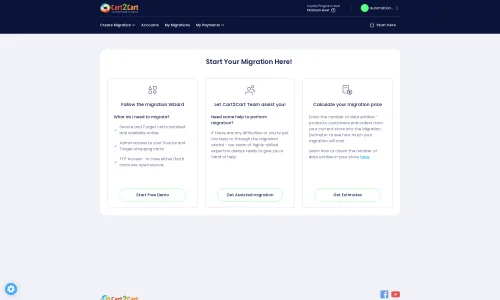
Step 1: Get Started
Your migration journey begins by initiating the process through the migration wizard. This user-friendly interface guides you through the entire data transfer, ensuring a clear and actionable path from start to finish.
Step 2: Connect Your Source Store (Basekit - via CSV)
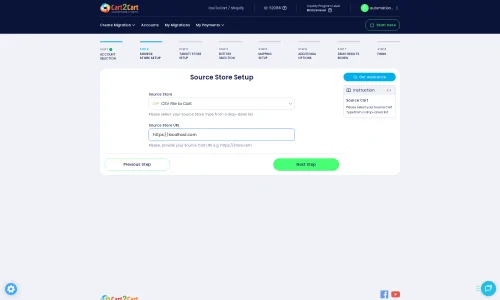
Since Basekit does not offer a direct connection method for automated migration tools, you will perform this step by specifying your exported CSV files as the source.
- Select Source Cart: From the dropdown menu, choose "CSV File to Cart" as your source shopping cart.
- Upload CSV Files: You will then be prompted to upload the CSV files you exported from your Basekit store. Ensure all relevant data – products, categories, customers, orders, reviews, CMS pages, etc. – are included in these files.
Step 3: Connect Your Target Store (CubeCart)
Next, you'll establish the connection to your new CubeCart platform, preparing it to receive your migrated data.
- Select Target Cart: Choose "CubeCart" from the list of supported target platforms.
- Enter Connection Details: Provide the necessary access credentials for your CubeCart store. This typically includes:
- Your CubeCart Store URL (
adminUrl) - Your CubeCart Admin Login (
adminLogin) - Your CubeCart Admin Password (
adminPwd)
- Your CubeCart Store URL (
- Install Bridge: The migration tool will instruct you to download a 'bridge' file and upload it to the root directory of your CubeCart installation via FTP. This bridge file facilitates a secure data exchange between the migration service and your CubeCart database. Remember that a specific Cart2Cart CubeCart Migration module is required and will need to be installed.
Step 4: Select Data Entities
This critical step allows you to define exactly which types of data you want to transfer from your Basekit CSV files to your new CubeCart store. The tool supports the migration of a wide range of entities to ensure comprehensive data transfer.
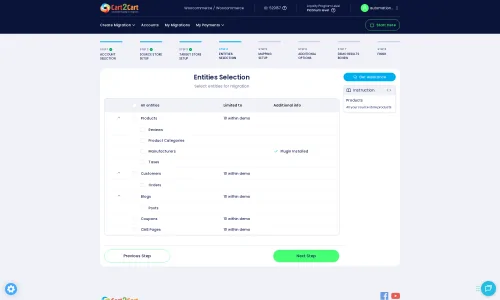
You can choose to migrate all available data entities or select them individually, based on your specific requirements. Common entities you'll want to migrate include:
- Products: Including product names, descriptions, images, SKUs, variants, prices, and stock levels.
- Product Categories: Maintaining your store's organizational structure.
- Customers: Transferring customer accounts, billing, and shipping addresses.
- Orders: Migrating complete order history, statuses, and associated customer details.
- Product Reviews: Preserving valuable social proof.
- Manufacturers, Taxes, Coupons, CMS Pages, and Invoices.
Step 5: Configure Additional Options & Data Mapping
To further customize your migration and ensure data consistency, you'll configure additional options and map your data fields.
Additional Migration Options
This section provides a suite of advanced settings to tailor the data transfer to your needs. Consider these important options:
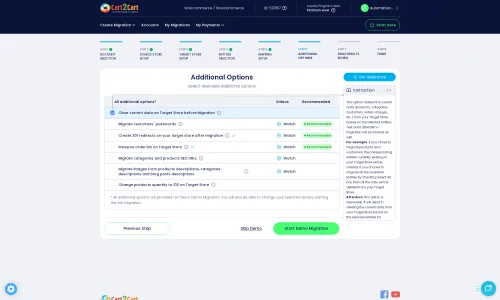
- Migrate Images in Description: Ensure product images embedded in descriptions are transferred correctly.
- Clear Target Store Data: If your CubeCart store isn't fresh, select this to remove existing data before migration.
- Preserve IDs: Options like Preserve Product IDs, Preserve Order IDs, and Preserve Customer IDs help maintain external references.
- SEO URLs & 301 SEO URLs: Crucial for preserving your SEO rankings and link equity. This feature automatically creates 301 redirects from your old Basekit URLs (if reconstructible from CSV) to your new CubeCart URLs, preventing broken links.
- Password Migration: Enable this to transfer customer passwords, allowing them to log into the new store with their existing credentials.
- Skip Custom Attributes: Useful if you don't need to transfer specific custom product attributes.
Data Mapping
Data mapping ensures that specific data fields from your Basekit CSV files correctly align with the corresponding fields in CubeCart. This is particularly important for:
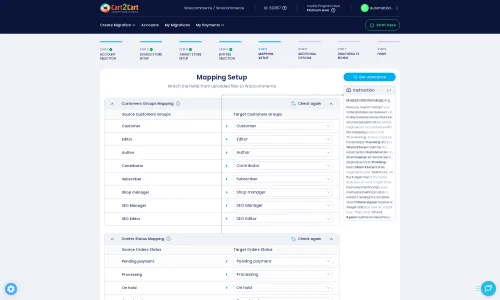
- Customer Groups Mapping: Match customer roles (e.g., 'Wholesale', 'Retail') from your source to appropriate groups in CubeCart.
- Order Status Mapping: Align order statuses (e.g., 'Pending', 'Processing', 'Completed') to ensure accurate historical records.
Careful data mapping maintains data integrity and provides a seamless user experience on your new platform.
Step 6: Run a Free Demo Migration (Recommended)
Before committing to a full data transfer, perform a free demo migration. This allows you to transfer a limited number of entities (e.g., 10-20 products, customers, and orders) to your CubeCart store.
- Verify Data: Use the demo to check the accuracy and integrity of the transferred data.
- Identify Issues: It's an excellent opportunity to spot and resolve any potential mapping errors or data inconsistencies.
- Review Functionality: Test how products, categories, and customer accounts appear and function on CubeCart.
A demo migration helps build confidence in the process and ensures a smoother full migration. You can learn more about this service here: Migration Preview Service.
Step 7: Initiate Full Migration
Once you are satisfied with the demo results and have resolved any issues, you are ready to proceed with the full migration.
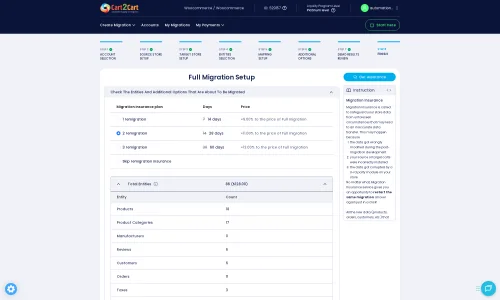
- Final Review: Double-check your selected entities, additional options, and data mapping.
- Choose Insurance (Optional): Consider adding a Migration Insurance Plan. This offers the flexibility of additional remigrations within a specified period, providing peace of mind. Find out how Migration Insurance works.
- Start Migration: Confirm your choices and initiate the full data transfer. The process will run on the cloud, so you don't need to keep your browser open.
Post-Migration Steps
Completing the data transfer is a significant achievement, but the journey to a fully optimized CubeCart store doesn't end there. These post-migration steps are crucial for ensuring your new store functions flawlessly and maintains its online visibility.
- Thorough Data Verification:
After the full migration is complete, meticulously check all aspects of your new CubeCart store:
- Products: Verify product details, images, prices, stock levels, variants, and descriptions.
- Categories: Ensure your product categories are correctly structured and linked.
- Customers: Check customer accounts, login functionality, and address books.
- Orders: Review historical order data, statuses, and associated customer information.
- Reviews & CMS Pages: Confirm all content has been accurately moved.
- Storefront Functionality Testing:
Beyond data, test the user experience:
- Navigation: Ensure menus and internal links work as expected.
- Search: Test the store's search functionality.
- Product Pages: Check display, add-to-cart, and options.
- Checkout Process: Perform test purchases from start to finish.
- Responsiveness: Verify your store looks and functions well on various devices.
- SEO Optimization & Redirects:
Maintaining your search engine rankings is paramount:
- 301 Redirects: Confirm that all 301 redirects from your old Basekit URLs to new CubeCart URLs are functioning correctly. This is vital for preserving link equity and preventing 404 errors.
- Google Analytics & Search Console: Update your Google Analytics and Search Console accounts to reflect your new CubeCart store's URL and submit a new sitemap.
- Monitor Rankings: Keep an eye on your SEO rankings post-migration.
- Configure Payment and Shipping Gateways:
Reconfigure and thoroughly test all your payment processors (e.g., PayPal, Stripe) and shipping methods within CubeCart to ensure smooth transactions.
- Reconnect Third-Party Integrations:
Integrate any essential third-party apps or services you used with Basekit (e.g., email marketing, accounting software, CRM) with your new CubeCart store.
- Update DNS Records:
Once you are fully confident that your CubeCart store is ready, update your domain's DNS records to point to your new CubeCart hosting. This will make your new store live to the public.
- Staff Training:
Provide training to your team on the new CubeCart administrative interface to ensure they can manage products, orders, and customer inquiries effectively.
- Consider Additional Services:
For ongoing data synchronization or if new data appears on your old store after the initial migration, consider services like Recent Data Migration Service or Cart2Cart Remigration Service to keep your CubeCart store up-to-date.
Migrating from Basekit to CubeCart is a significant undertaking, but with careful planning and execution, it can be a smooth and rewarding process. By following this comprehensive guide, you'll be well-equipped to transition your e-commerce business to its new home.
Ways to perform migration from Basekit to CubeCart
Automated migration
Just set up the migration and choose the entities to move – the service will do the rest.
Try It Free
Data Migration Service Package
Delegate the job to the highly-skilled migration experts and get the job done.
Choose Package
Custom Migration
Need metafields, SEO URLs, variant rules, or other tailored mapping? Explore customizations built for real merchant demand.
Browse Customizations

Benefits for Store Owners

Benefits for Ecommerce Agencies

The design and store functionality transfer is impossible due to Basekit to CubeCart limitations. However, you can recreate it with the help of a 3rd-party developer.

Your data is safely locked with Cart2Cart
We built in many security measures so you can safely migrate from Basekit to CubeCart. Check out our Security Policy
Server Security
All migrations are performed on a secure dedicated Hetzner server with restricted physical access.Application Security
HTTPS protocol and 128-bit SSL encryption are used to protect the data being exchanged.Network Security
The most up-to-date network architecture schema, firewall and access restrictions protect our system from electronic attacks.Data Access Control
Employee access to customer migration data is restricted, logged and audited.Frequently Asked Questions
What specific data entities can be migrated from Basekit to CubeCart?
Can customer passwords be migrated from Basekit to CubeCart?
Should I use an automated tool or hire an expert for Basekit to CubeCart migration?
Is my Basekit store data secure during the transfer to CubeCart?
What factors influence the cost of migrating from Basekit to CubeCart?
How can I preserve SEO rankings when migrating from Basekit to CubeCart?
Will my Basekit store's design and theme transfer automatically to CubeCart?
Will my Basekit store experience downtime during migration to CubeCart?
How long does a Basekit to CubeCart migration typically take?
How can I ensure data accuracy after migrating from Basekit to CubeCart?
Why 150.000+ customers all over the globe have chosen Cart2Cart?
100% non-techie friendly
Cart2Cart is recommended by Shopify, WooCommerce, Wix, OpenCart, PrestaShop and other top ecommerce platforms.
Keep selling while migrating
The process of data transfer has no effect on the migrated store. At all.
24/7 live support
Get every bit of help right when you need it. Our live chat experts will eagerly guide you through the entire migration process.
Lightning fast migration
Just a few hours - and all your store data is moved to its new home.
Open to the customers’ needs
We’re ready to help import data from database dump, csv. file, a rare shopping cart etc.
Recommended by industry leaders
Cart2Cart is recommended by Shopify, WooCommerce, Wix, OpenCart, PrestaShop and other top ecommerce platforms.
Trusted by eCommerce dominators since 2009















Very impressed with cart2cart. We used it to migrate userbase and productbase from OsCommerce to Cubecart. Excellent support – even when dealing with a database issue in one of the carts, not really to do with cart2cart! I would recommend.
Review source

Great Solution! Excellent Support team which helped to migrate my store data from Magento to Bigcommerce in no time. Cart2Cart developed a custom solution to which helped me to Migrate my Blog Data too. I will surely use their service on my upcoming projects.
Review source

Migration from Shopify to BigCommerce was exactly what I need it. Customers information, orders, products description and images were displayed in my new platform perfectly. Additionally, the support team were very helpful and patience while I was doing all of this process. I highly recommend it!
Review source

Working with Cart2Cart on a recent Yahoo Store to BigCommerce Store migration was a pleasure. The support was very helpful in getting to my end solution. I would definitely recommend their service for anyone looking to migrate data between these platforms.
Review source

Solid work on the cart2cart migration from Magento to BigCommerce! Also, they helped me a lot for the data re-migration due to an accidental deletion on BigCommerce I definitely would recommend Cart2Cart 🙂
Review source

I have been very happy with the service and support of Cart2Cart in migrating from an older WebAsyst based e-commerce site to a much more modern CS-Cart based one. Worked perfectly!
Review source
Very good support. They migrated our store from Big Cartel to Magento, and were very cooperative during all this process. Thank you team. I recommend them to everyone
Review source
I have successfully used Cart2Cart to migrate products & categories from DrupalCommerce to Magento. It’s easy, affordable and they offer decent support (no I’m not affiliated with them).
Review source
we have already contracted the service three times to migrate from prestashop to magento. We were very well catered for. I recommend!
Review source
Many of my customers have Magento 1 stores. This year Magento will stop supporting this system and because of this these customers need to migrate to another system. Migration can be difficult and very time consuming process. But then i found Cart2Cart. There solution is the best and affordable. With the first migration there where some problems, but i did made some mistakes with filling in the correct fields to get a connection between the current and the target store. After starting a chat these problems where fixed very quickly. Support is very good and there solution is very affordable. The perfect solution!
Review source