
Currently, the popularity of hosted e-Commerce platforms almost matches the open-source ones. Mostly, they are celebrated among startups and newbie e-sellers for one main reason - their utter simplicity. It’s as easy to sell on a hosted solution as it is on a marketplace. But with a shopping cart, you’ll have way more opportunities. For those looking for a seamless transition, our basic data migration service offers a straightforward path. According to various stats, our own ones and general web stats, the top three carts of the category are - Volusion, Bigcommerce, and Shopify. That’s why now we’re posting Volusion vs Bigcommerce vs Shopify comparison.
We hope it’ll help you make the decision. Enjoy!
Shopify

As far as popularity goes - Shopify is far in the lead.
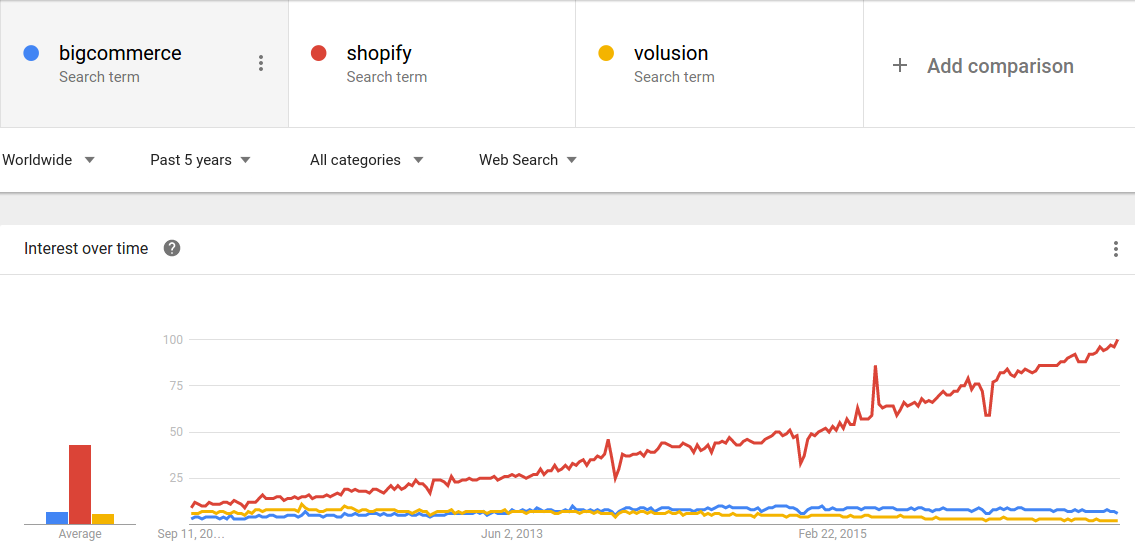
It doesn't necessarily indicate functionality greatness - may be a good work of Shopify’s marketing. However, there’s no smoke without fire - there are many attractive traits about the cart that makes many people love it.
Ease of use
Shopify is famously simple - it’s set up within minutes and doesn’t require any technical knowledge to customize looks and add products. I think it’s admin panel is a golden standard of how a clear and convenient dashboard should look. No unnecessary features to bloat the view and confuse the user.
Functionality
In particular, our customers named such reasons of moving to Shopify - “Unlimited bandwidth and customization options”, ”Lots of apps and marketing tools, great SEO and design options”, “Best design templates out there in a big selection”, “Ability to easily integrate with other systems”. These are real quotes - reasons that made Cart2Cart clients switch to Shopify. Consider them.
Pricing plans
Shopify's main plans are Basic ($39), Shopify ($105) and Advanced Shopify ($399). There is a short free trial period offered by all plans. Plans differ in provided functionality, but all offer an unlimited number of products and file storage, which is gold. Additionally, there’s an opportunity to sell offline and online simultaneously. But you’ll have to contact Shopify’s team to establish the price of that.
Another option is Shopify Plus, an enterprise cart edition plan, that seems to be positioning itself as a separate SaaS platform - it doesn't have the standard price as well.
Design
It doesn’t matter how many reviews you browse, you’ll find only ecstatic praises of Shopify themes. They’re 100% responsive. They look stylish, professional and, in Shopify’s general fashion, are easy to modify.
You can choose from a wide selection of free themes or a paid one, to make your store look even more unique. Beware of a little catch - paid themes are easier to customize than free ones. That’s Shopify’s way to incline you towards spending money, I guess. But we can’t blame them for that, it’s just business.
If you, miraculously, can’t find an appropriate theme among Shopify’s ones - upload your own, that’s allowed.
BigCommerce

As for the Bigcommerce vs Shopify comparison - carts used to be back-to-back competitors, until Bigcommerce raised its prices. Now, the cart appears to be aiming at the richer, enterprise clients than at e-Commerce beginners.
Ease of use
The platform is great - polished and intuitive. When you log in to the admin panel, it shows you what there’s to do to get your store running: Add Products, Set Up Shipping, etc. Similarly to Shopify, it provides modules for customization, accepting credit cards, etc. This is helpful and interesting, especially for someone inexperienced.
Customization
-
- The procedure of adding products is clean and API access can be obtained easily. It doesn’t matter what technical level you’re on, Bigcommerce usability will impress you.
Functionality
It is a bit more difficult to master BigCommerce than Shopify. But it is just as (or even more in some instances) advanced. The cart provides lots of great tools out of the box, whereas Shopify requires the installation of additional modules to expand the basic, starting functionality.
Platform’s marketing and SEO tools are worth attention. Title tags, descriptions and keywords to each product, custom URLs, ability to modify robot.txt, make your own 301 redirects and much much more - are all at your disposal.
When it comes to promotion Bigcommerce stands out big time. Regarding other features - they are as robust as the ones on Shopify, just a little harder to manage.
Price
There are a couple of Bigcommerce pricing plans - Standard - $39, Plus - $105, Pro - $399 and Enterprise - the price is revealed upon request. Unlimited bandwidth in each plan, a good set of features even in the cheapest one, and increasingly powerful functionality with each upgrade - the usual and effective system. You should note that plans have annual sales volume limits. Exceeding these limits may lead to needing to upgrade to an Enterprise plan. This approach is different from Shopify's, and many store owners moving from other platforms often become our clients to migrate their businesses.
Design
Bigcommerce offers numerous high-level design themes. They surpass the ones on Volusion in terms of quality, but, in my opinion, are less sophisticated than Shopify’s templates.
You can upload your own themes, but the procedure is trickier than on Shopify. Our migration customization service can assist with complex theme transfers.
Volusion

Finally, we get to a cart that’s, in recent analyses, often shows lower search interest compared to the others in our comparison. However, let’s not forget - it’s among the top carts in the world, and reputable companies like Intel have been their clients.
Ease of use
Volusion, though not similar to Shopify and Bigcommerce in its administration ways, is still easy to navigate. It has a steeper learning curve, but it won’t take you long to get a grip on it. For common questions or issues, consult our detailed FAQ section. Volusion has published a series of videos to get people acquainted with how their stores are managed. They’re trying, that’s admirable.
Functionality
Though SEO functionality is built-in, it isn’t as easy to manage as on Shopify, and it is less advanced than on Bigcommerce.
Volusion’s approach to cart abandonment allows you to view visitors who left without purchasing, with items still in their carts. This functionality can be found even in its starter plan. However, for features like automated follow-up emails, it often requires manual intervention or additional paid plugins for advanced automation, potentially offering a more basic solution compared to competitors' native offerings.
It is worth to say Volusion features are great to beginners, just less advanced than the ones on two previous carts.
Price
Volusion offers several pricing plans based on annual Gross Merchandise Volume (GMV): Personal (starting at $35/month for up to $50k in sales), Professional (starting at $165/month for up to $200k in sales), Business (starting at $299/month for up to $500k in sales), and Prime (custom pricing for higher sales volumes). Unlike its competitors, Volusion's pricing is tied to your sales volume from the start, which can be a key factor for growing businesses. Considering that Shopify and Bigcommerce allow unlimited products on their starting plans without GMV restrictions, Volusion’s pricing structure requires careful consideration based on your sales projections. For assistance with planning your migration, you might consider our migration customization service.
Design
Though there is a decent selection of themes on Volusion they are not all responsive and so modern and stylish that the ones on Shopify or Bigcommerce. Also, templates are harder to edit. If you’re not a developer who’s comfortable with HTML and CSS, it’s going to take time and effort to really make the store look your own.
| Platform | Price | Active Stores | Ecommerce Features |
| Shopify | $39 | Millions |
|
| BigCommerce | $39 | Hundreds of thousands |
|
| Volusion | $35 | Tens of thousands |
|
Volusion vs Shopify vs Bigcommerce - FAQs
How does BigCommerce compare to Shopify?
In general, both Shopify and BigCommerce are strong contenders for businesses of varying sizes, with Shopify often favored for its vast ecosystem and BigCommerce for its robust built-in features and scalability. Both platforms offer highly customized and powerful solutions, but BigCommerce is frequently highlighted for its strengths in supporting omnichannel growth and catering to higher-volume enterprise operations.
Is Shopify a good idea?
Overall rating. The Shopify eCommerce platform is one of the most popular on the market today, especially if you're running a large business. With hundreds of built-in features and thousands of apps, it allows people to build their own, scalable online store.
Conclusion
It’s hard to really compare Volusion vs Bigcommerce or Shopify vs Volusion or Shopify vs Bigcommerce because, in the end, it all comes down to your needs and location. Shopify is great, easy, and has similar starting prices to BigCommerce, offering robust global capabilities and localized features across various markets, including Europe. BigCommerce is also highly international. Volusion is another high-level platform, but it traditionally requires some HTML and CSS knowledge from you for deeper customization. Weigh all the uplisted factors and conduct your own research using a comprehensive checklist before choosing the e-Commerce solution.
If you’ve made up your mind already - Cart2Cart will gladly help you to migrate to or from any of these platforms. Perform a Free Demo migration with Cart2Cart service right now!
Good luck with your business!
Monthly Update – March 2026
In the rapidly evolving e-commerce landscape of March 2026, staying competitive means embracing advanced analytics and truly understanding customer behavior beyond basic demographics. A key trend we're observing is the shift towards predictive personalization powered by sophisticated AI. Retailers are now leveraging AI to anticipate customer needs, offering highly tailored product recommendations, dynamic pricing, and even proactive customer support, often before the customer explicitly articulates a need. This deep level of insight is transforming the shopping journey from a transactional event into a continuous, engaging dialogue. Furthermore, the importance of a seamless omnichannel experience cannot be overstated; customers expect a consistent and personalized interaction whether they're browsing on mobile, desktop, or interacting with in-store digital touchpoints. Ensuring your e-commerce platform can collect and unify data across these channels is paramount for effective AI implementation and delivering the bespoke experiences modern consumers demand. Investing in data infrastructure and AI capabilities now will be crucial for sustained growth and customer loyalty in the coming years.
For more details, explore our FAQ section or schedule a call with a migration expert.