


ShopOS to Ecwid Migration - Step-by-Step Guide & Expert Services
ShopOS to Ecwid migration becomes effortless with Cart2Cart. Planning to move ShopOS store to Ecwid, or looking to switch from ShopOS to Ecwid? Our advanced automated service ensures a secure, fast, and SEO-friendly transfer data process, safeguarding all your crucial information with zero downtime. Whether you're seeking a comprehensive step-by-step guide for a DIY approach or require expert assistance to manage it entirely, we simplify your ShopOS to Ecwid migration.
What data can be
migrated from ShopOS to Ecwid
-
Products
-
Product Categories
-
Manufacturers
-
Customers
-
Orders
- Name, ID, SKU, Short Description, Full Description, Manufacturer, Tax Class, Sort Order.
- MSRP.
- Meta Title, Meta Keywords, Meta Description.
- Quantity, Stock Availability.
- Weight.
- Options(Name, Price).
- Name, Status.
- Meta Title, Meta Description, Meta Keywords.
- Name.
- ID, Telephone, Newsletter, Gender, Created Date.
- Customer Billing Address.
- Customer Shipping Address.
- ID, Order Date, Order Status, Order Products(Final Price, Tax Value, Name, SKU), SubTotal Price, Discount Price, Tax Price, Shipping Price, Total Price.
- Customer Name, Email, Telephone, Billing Address.
- Shipping Address.
- Name, ID, SKU, Short Description, Full Description, Manufacturer, Tax Class, Sort Order.
- MSRP.
- Meta Title, Meta Keywords, Meta Description.
- Quantity, Stock Availability.
- Weight.
- Options(Name, Price).
- Name, Status.
- Meta Title, Meta Description, Meta Keywords.
- Name.
- ID, Telephone, Newsletter, Gender, Created Date.
- Customer Billing Address.
- Customer Shipping Address.
- ID, Order Date, Order Status, Order Products(Final Price, Tax Value, Name, SKU), SubTotal Price, Discount Price, Tax Price, Shipping Price, Total Price.
- Customer Name, Email, Telephone, Billing Address.
- Shipping Address.
Products
Estimate your Migration Cost
To check your ShopOS to Ecwid migration price, click the button below. The migration price may vary depending on the number of data types and the additional migration options selected.
How to Migrate from ShopOS to Ecwid In 3 Steps?
Connect your Source & Target carts
Choose ShopOS and Ecwid from the drop-down lists & provide the stores’ URLs in the corresponding fields.
Select the data to migrate & extra options
Choose the data you want to migrate to Ecwid and extra options to customise your ShopOS to Ecwid migration.
Launch your Demo/Full migration
Run a free Demo to see how the Cart2Cart service works, and when happy - launch Full migration.
Migrate ShopOS to Ecwid: The Ultimate 2025 Guide
Seamlessly Migrate Your E-commerce Store from ShopOS to Ecwid
Embarking on an e-commerce platform replatforming journey can seem daunting, but with the right guidance, it's an opportunity to revitalize your online presence. This comprehensive guide is designed to help merchants like you smoothly transition their online store from ShopOS to Ecwid. Given that ShopOS typically facilitates data export through CSV files, our migration strategy will leverage this method to ensure a precise and complete data transfer.
Ecwid offers a flexible, embedded e-commerce solution that can be integrated into any website, blog, or social media platform, providing a modern and user-friendly experience for both merchants and customers. By following these expert steps, you'll be able to move all your vital store data, including products, customers, and orders, to your new Ecwid store with confidence and minimal downtime.
Prerequisites for a Successful Migration
Before you begin the data transfer process, a thorough preparation phase is crucial. This ensures a smooth transition and minimizes potential issues.
- For Your ShopOS Store (Source):
- Data Export: You will need administrative access to your ShopOS store to export all relevant data. This typically includes products (with SKUs, variants, descriptions, images), product categories, customer records, order history, and potentially product reviews or CMS pages. These will be exported into CSV files, forming the basis of your source data.
- Data Backup: Always perform a complete backup of your ShopOS store data before initiating any migration. This is a critical safety measure.
- For Your Ecwid Store (Target):
- Active Ecwid Account: Ensure you have an active Ecwid account set up. You can create one if you haven't already.
- Install Cart2Cart Ecwid Migration App: Ecwid requires the installation of a dedicated app for API-based migrations. Search for and install the "Cart2Cart Ecwid Migration App" from the Ecwid App Market.
- API Access Credentials: You will need to locate your Ecwid Store ID and generate an Access Token to allow the migration tool to connect securely. This typically involves accessing your Ecwid admin panel, navigating to 'Settings' > 'API' or 'Apps' to generate the necessary API scopes and tokens. Ecwid's API requires HTTPS for secure connections, which is standard. For more details on credentials, consult The Short & Essential Guide to Access Credentials for Cart2Cart.
- General Preparation:
- Audit Your Data: Take this opportunity to clean up old, irrelevant data from your ShopOS store. This includes outdated products, inactive customer accounts, or redundant categories.
- Inform Stakeholders: If possible, inform your customers about the upcoming transition to manage expectations and avoid confusion.
- Review SEO Strategy: Plan how you will manage SEO during and after the migration. Identify key URLs and plan for 301 redirects to preserve link equity and search engine rankings.
For more detailed guidance on preparing your stores, refer to our FAQs: How to prepare Source store for migration? and How to prepare Target store for migration?
Performing the Migration: A Step-by-Step Guide
This section outlines the process of migrating your ShopOS data to Ecwid using a migration wizard, leveraging CSV files for the source data.
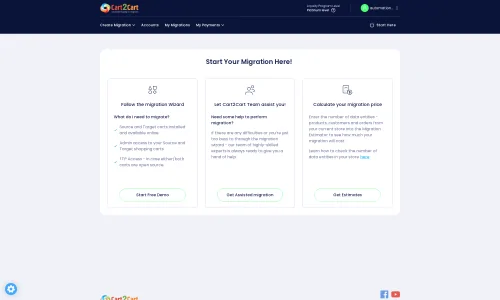
Step 1: Start Your Migration
Begin by navigating to the migration wizard interface. This is your starting point for setting up the data transfer.
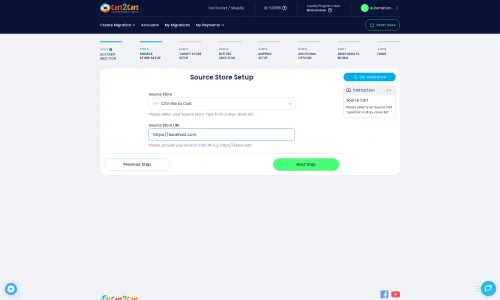
Step 2: Set Up Your Source Store (ShopOS via CSV)
Since ShopOS is not directly supported by all migration tools, we will use the CSV file import method. Select "CSV File to Cart" as your Source Shopping Cart. You will then upload the CSV files containing your ShopOS data, such as products, customers, categories, and orders. Ensure your CSV files are well-structured to facilitate accurate data parsing.
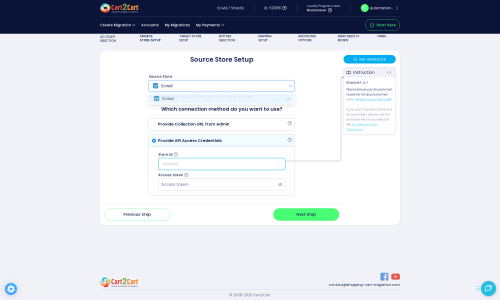
Step 3: Set Up Your Target Store (Ecwid)
Next, select "Ecwid" as your Target Shopping Cart. To establish a secure connection, you will need to provide your Ecwid Store ID and Access Token. These API access credentials allow the migration service to interact with your Ecwid store and transfer data. Remember that the "Cart2Cart Ecwid Migration App" must be installed on your Ecwid store beforehand.
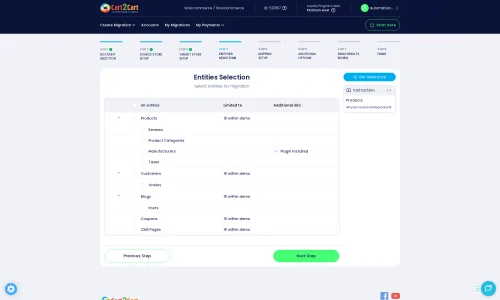
Step 4: Select Data Entities for Migration
In this crucial step, you choose which specific data entities you wish to transfer from your ShopOS CSV files to Ecwid. You can select all available entities or pick them individually. Common entities include:
- Products (including SKUs, variants, attributes)
- Product Categories
- Customers (with their personal data)
- Orders (with order IDs, statuses)
- Product Reviews
- CMS Pages
- Coupons
Step 5: Configure Additional Options and Data Mapping
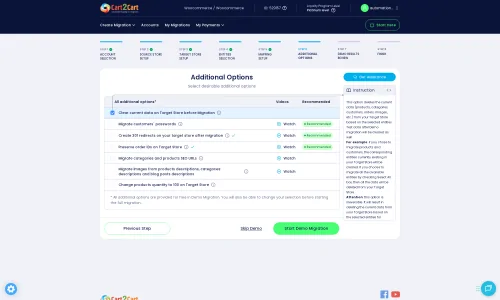
This stage allows for fine-tuning your migration. You'll find a range of "Additional Options" that can significantly enhance your data transfer:
- Clear Target Store Data: The option to Clear current data on Target store before migration is recommended if your Ecwid store is new or contains test data you wish to remove.
- Preserve Order IDs: This option helps maintain data integrity by retaining your original order identification numbers. Learn more about How Preserve IDs options can be used?
- Migrate Images in Description: Ensure product images embedded within descriptions are transferred.
- SEO URLs & 301 Redirects: Crucial for preserving your search engine rankings and link equity. Selecting "Create 301 SEO URLs" helps automatically set up redirects for old ShopOS URLs to their new Ecwid counterparts, preventing broken links.
- Migrate All Categories: Ensures your entire product category structure is moved.
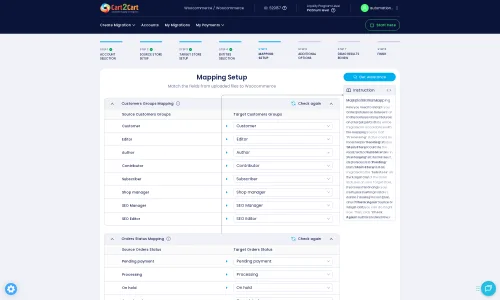
Following additional options, you will perform "Data Mapping." This involves matching customer groups and order statuses from your ShopOS data to their equivalent fields in Ecwid. Accurate mapping ensures that customer roles and order processing states are correctly interpreted in your new store.
Step 6: Run a Free Demo Migration (Highly Recommended)
Before committing to a full migration, execute a free demo. This migrates a limited number of entities (e.g., 10-20 products, customers, and orders) to your Ecwid store. It's an invaluable step to:
- Verify data transfer accuracy.
- Identify and troubleshoot any potential mapping or compatibility issues.
- Familiarize yourself with the process.
Step 7: Initiate Full Migration
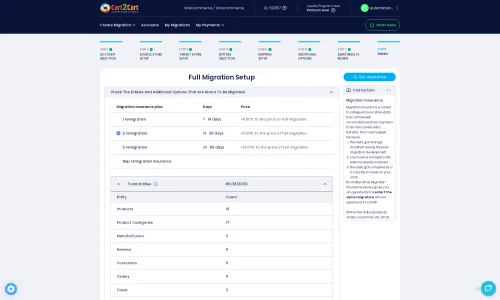
Once you are satisfied with the demo results, proceed with the full migration. Review your selections and consider adding a Migration Insurance Service, which offers remigrations in case you need to run the process again or import recent data. This ensures peace of mind during the transition.
Post-Migration Steps: Setting Up Your Ecwid Store for Success
The migration doesn't end when the data transfer is complete. Several crucial steps remain to ensure your new Ecwid store is fully functional, optimized, and ready for customers.
- 1. Data Verification: Rigorously check all migrated data. Navigate through your Ecwid admin panel and verify:
- Products: Ensure all products, SKUs, variants, images, descriptions, prices, and stock levels are accurate.
- Categories: Confirm your product category structure is intact and logical.
- Customers: Check customer accounts, ensure basic details are present.
- Orders: Review a selection of orders to ensure historical data, statuses, and customer associations are correct.
- Reviews: Verify that all product reviews have been successfully transferred.
- 2. Configure Your Ecwid Store Settings:
- Payment Gateways: Set up and test your preferred payment methods (e.g., PayPal, Stripe, Square).
- Shipping Methods: Configure your shipping zones, rates, and carriers.
- Taxes: Define your tax settings according to your business location and legal requirements.
- Storefront Localization: Adjust language and currency settings if applicable.
- 3. Customize Your Ecwid Design:
- Theme Selection: Choose a suitable theme or template for your Ecwid store.
- Branding: Upload your logo, set your brand colors, and customize fonts to align with your brand identity.
- Navigation: Optimize your store's navigation menus for an intuitive user experience.
- 4. Install Essential Apps:
Explore the Ecwid App Market for apps that can enhance your store's functionality, such as marketing tools, accounting integrations, or advanced analytics.
- 5. Implement SEO Best Practices & Redirects:
- 301 Redirects: If you used the "Create 301 SEO URLs" option during migration, double-check that they are functioning correctly. If you have any remaining URLs that changed, manually set up 301 redirects to preserve link equity and prevent 404 errors. This is vital for maintaining your SEO rankings.
- Google Search Console: Update your sitemap and notify Google about your site migration via Google Search Console. Monitor for any crawling errors or indexing issues.
- Internal Links: Update any hardcoded internal links on your website or blog to point to the new Ecwid URLs.
- 6. Thorough Testing:
- Place Test Orders: Act as a customer and go through the entire purchase process, from adding items to the cart to checkout and payment confirmation.
- Customer Account Creation: Test new customer registrations and existing customer logins.
- Responsiveness: Ensure your Ecwid store functions flawlessly across various devices (desktop, tablet, mobile).
- 7. Go Live and Monitor:
Once you've completed all post-migration checks and are confident in your new Ecwid store, make it live. Continue to monitor your store's performance, user feedback, and analytics data closely to address any unforeseen issues promptly.
By following these steps, you'll ensure a smooth and successful transition, empowering your business with the enhanced capabilities of your new Ecwid store.
Ways to perform migration from ShopOS to Ecwid
Automated migration
Just set up the migration and choose the entities to move – the service will do the rest.
Try It Free
Data Migration Service Package
Delegate the job to the highly-skilled migration experts and get the job done.
Choose Package

Benefits for Store Owners

Benefits for Ecommerce Agencies

The design and store functionality transfer is impossible due to ShopOS to Ecwid limitations. However, you can recreate it with the help of a 3rd-party developer.

Your data is safely locked with Cart2Cart
We built in many security measures so you can safely migrate from ShopOS to Ecwid. Check out our Security Policy
Server Security
All migrations are performed on a secure dedicated Hetzner server with restricted physical access.Application Security
HTTPS protocol and 128-bit SSL encryption are used to protect the data being exchanged.Network Security
The most up-to-date network architecture schema, firewall and access restrictions protect our system from electronic attacks.Data Access Control
Employee access to customer migration data is restricted, logged and audited.Frequently Asked Questions
Will my ShopOS store go offline during migration to Ecwid?
How can I keep SEO rankings when switching from ShopOS to Ecwid?
Is it possible to transfer my ShopOS store's design or theme to Ecwid?
Can customer passwords be transferred from ShopOS to Ecwid?
How can I ensure data accuracy after migrating from ShopOS to Ecwid?
What data can be migrated from ShopOS to Ecwid during replatforming?
How is data security ensured during the ShopOS to Ecwid migration?
Is an automated tool or expert service better for ShopOS to Ecwid migration?
What factors determine the cost of a ShopOS to Ecwid store migration?
What is the estimated timeline for a ShopOS to Ecwid store migration?
Why 150.000+ customers all over the globe have chosen Cart2Cart?
100% non-techie friendly
Cart2Cart is recommended by Shopify, WooCommerce, Wix, OpenCart, PrestaShop and other top ecommerce platforms.
Keep selling while migrating
The process of data transfer has no effect on the migrated store. At all.
24/7 live support
Get every bit of help right when you need it. Our live chat experts will eagerly guide you through the entire migration process.
Lightning fast migration
Just a few hours - and all your store data is moved to its new home.
Open to the customers’ needs
We’re ready to help import data from database dump, csv. file, a rare shopping cart etc.
Recommended by industry leaders
Cart2Cart is recommended by Shopify, WooCommerce, Wix, OpenCart, PrestaShop and other top ecommerce platforms.
Trusted by eCommerce dominators since 2009
















Great Solution! Excellent Support team which helped to migrate my store data from Magento to Bigcommerce in no time. Cart2Cart developed a custom solution to which helped me to Migrate my Blog Data too. I will surely use their service on my upcoming projects.
Review source

Migration from Shopify to BigCommerce was exactly what I need it. Customers information, orders, products description and images were displayed in my new platform perfectly. Additionally, the support team were very helpful and patience while I was doing all of this process. I highly recommend it!
Review source

Working with Cart2Cart on a recent Yahoo Store to BigCommerce Store migration was a pleasure. The support was very helpful in getting to my end solution. I would definitely recommend their service for anyone looking to migrate data between these platforms.
Review source

Solid work on the cart2cart migration from Magento to BigCommerce! Also, they helped me a lot for the data re-migration due to an accidental deletion on BigCommerce I definitely would recommend Cart2Cart 🙂
Review source

I have been very happy with the service and support of Cart2Cart in migrating from an older WebAsyst based e-commerce site to a much more modern CS-Cart based one. Worked perfectly!
Review source

Very good support. They migrated our store from Big Cartel to Magento, and were very cooperative during all this process. Thank you team. I recommend them to everyone
Review source
I have successfully used Cart2Cart to migrate products & categories from DrupalCommerce to Magento. It’s easy, affordable and they offer decent support (no I’m not affiliated with them).
Review source
we have already contracted the service three times to migrate from prestashop to magento. We were very well catered for. I recommend!
Review source
Many of my customers have Magento 1 stores. This year Magento will stop supporting this system and because of this these customers need to migrate to another system. Migration can be difficult and very time consuming process. But then i found Cart2Cart. There solution is the best and affordable. With the first migration there where some problems, but i did made some mistakes with filling in the correct fields to get a connection between the current and the target store. After starting a chat these problems where fixed very quickly. Support is very good and there solution is very affordable. The perfect solution!
Review source
We were in need of migrating 10.000 orders & customers from a PrestaShop site to a Magento site, already being in use. We therefore needed to be extra careful not to erase any of the existing data, which is why we seeked out the service of Cart2Cart. With a readily available customer service providing guidance and support during the entire process, we felt secure in the choice of Cart2Cart. We also enjoyed the possibility to do a test migration to be able to verify the values, before going ahead with a full migration. The full migration was surprisingly quick, within just a couple of minutes we had successfully transfered all the data, without experiencing any issues on the site. I’d recommend Cart2Cart to anyone who are looking to simplify the process of migrating.
Review source