

Lightspeed POS to Shopware Migration - Step-by-Step Guide & Expert Services
Lightspeed POS to Shopware migration just got easier. Seamlessly move Lightspeed POS store to Shopware with Cart2Cart's expert services. Discover how to safely transfer data, ensuring full SEO preservation, zero downtime, and complete data security. Whether you're ready to switch from Lightspeed POS to Shopware yourself with our step-by-step guide or prefer a fully managed solution, we make your Lightspeed POS to Shopware migration fast and reliable. Get started today!
What data can be
migrated from Lightspeed POS to Shopware
-
Products
-
Product Categories
-
Manufacturers
-
Taxes
-
Customers
-
Coupons
Estimate your Migration Cost
To estimate your Lightspeed POS to Shopware migration price, click the button below. The migration price may vary depending on the number of data types and the additional migration options selected.
How to Migrate from Lightspeed POS to Shopware In 3 Steps?
Connect your Source & Target carts
Choose Lightspeed POS and Shopware from the drop-down lists & provide the stores’ URLs in the corresponding fields.
Select the data to migrate & extra options
Choose the data you want to migrate to Shopware and extra options to customise your Lightspeed POS to Shopware migration.
Launch your Demo/Full migration
Run a free Demo to see how the Cart2Cart service works, and when happy - launch Full migration.
Migrate Lightspeed POS to Shopware: The Ultimate 2025 Guide
Seamlessly Migrate from Lightspeed POS to Shopware: Your Definitive Guide
Are you looking to enhance your e-commerce capabilities, improve scalability, or simply explore a more robust platform for your online store? Transitioning from Lightspeed POS to Shopware can be a strategic move to unlock new growth opportunities and deliver a superior customer experience. While Lightspeed POS is a powerful point-of-sale system, moving your extensive product catalog, customer data, and order history to a dedicated e-commerce platform like Shopware requires careful planning and execution.
This comprehensive guide will walk you through the entire process of migrating your e-commerce data from Lightspeed POS to Shopware, leveraging a CSV file export for your source data and the powerful capabilities of Shopware as your target platform. We'll cover everything from essential prerequisites to post-migration verification, ensuring a smooth and successful data transfer. Prepare to elevate your online retail presence with Shopware's flexible and feature-rich environment.
Prerequisites for a Successful Migration
Before embarking on your data migration journey, ensuring both your source (Lightspeed POS via CSV) and target (Shopware) environments are adequately prepared is crucial. Proper preparation minimizes downtime, prevents data loss, and sets the stage for a seamless transition.
- Lightspeed POS Data Export: Since Lightspeed POS is a point-of-sale system and not directly supported via a bridge connection for full e-commerce migration, your data will be exported into CSV (Comma Separated Values) files. You will need to export your products, product categories, manufacturers, customer records, order history, and any other relevant e-commerce data into well-structured CSV files. Ensure these files contain comprehensive data, including SKUs, variants, descriptions, images, pricing, and customer metadata. Refer to Lightspeed POS documentation for detailed export procedures.
- Fresh Shopware Installation: Have a clean, functioning installation of Shopware (versions 5.2.2 or 6.0.0+ are supported) ready to receive your migrated data. Ensure you have full administrative access to its backend.
- FTP/SFTP Access: For establishing a secure connection to your Shopware store, you will need FTP or SFTP access to your Shopware server's root directory. This is necessary for uploading the Cart2Cart Connection Bridge file. If you're unsure about this, consult your hosting provider or refer to our guide on finding your root folder.
- Cart2Cart Shopware Migration Module: Shopware requires the installation of a specific Cart2Cart Shopware Migration module to facilitate the data transfer. Ensure this plugin is installed in your Shopware instance before starting.
- Backup Your Data: Always perform a complete backup of your current Lightspeed POS data (your CSV exports) and your new Shopware installation before starting any migration. This is a critical step for data integrity and recovery.
- Review Access Credentials: Confirm you have all necessary access details for both your CSV files and your Shopware admin panel and FTP. For more details, consult The Short & Essential Guide to Access Credentials for Cart2Cart.
For more detailed preparation guidelines, you can also consult our FAQs: How to prepare Target store for migration? and How to prepare Source store for migration?
Performing the Migration: A Step-by-Step Guide
Migrating your store's data with Cart2Cart is a streamlined process. Follow these steps to ensure all your valuable e-commerce information is transferred accurately from your Lightspeed POS CSV files to Shopware.
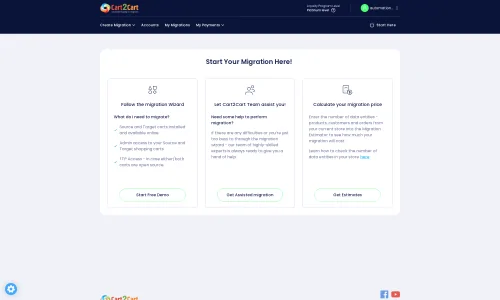
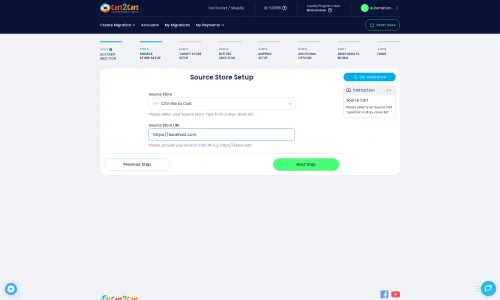
Step 1: Choose Your Source Platform (Lightspeed POS via CSV)
Begin by selecting your source platform. Since Lightspeed POS data will be migrated via CSV files, choose 'CSV File to Cart' as your source cart type. You'll then be prompted to upload your prepared CSV files containing your Lightspeed POS data.
As you upload your CSV files, the migration wizard will analyze their structure, preparing for the upcoming data transfer. Ensure your CSVs are well-formatted to guarantee accurate data parsing.
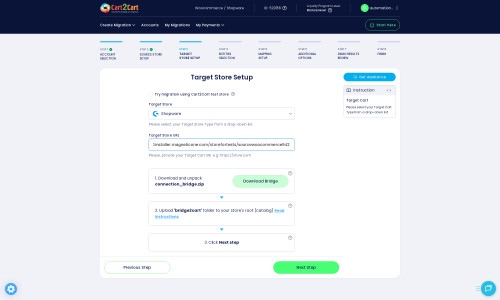
Step 2: Connect to Your Shopware Target Store
Next, designate 'Shopware' as your target e-commerce platform. Provide your Shopware store's URL. To establish a secure data link, you will be prompted to download a 'Connection Bridge' file.
Unpack this bridge file and upload the 'bridge2cart' folder to the root directory of your Shopware installation via FTP/SFTP. This bridge acts as a secure conduit, allowing the migration service to access and transfer data between your CSV files and your Shopware store.
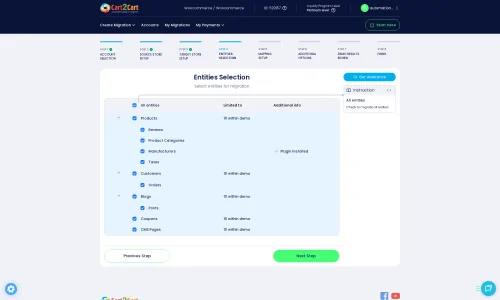
Step 3: Select Data Entities for Migration
This critical step allows you to choose exactly which types of data you wish to migrate from your Lightspeed POS CSV files to Shopware. You can select individual entities or choose to transfer all available data with a single click.
The common data entities you can transfer include:
- Products (including SKUs, variants, attributes, descriptions, and images)
- Product Categories
- Product Manufacturers
- Product Reviews
- Customers (with associated customer data)
- Orders (with order history)
- Invoices
- Taxes
- Stores
- Coupons
- CMS Pages (content pages)
While your Lightspeed POS CSVs might contain blog posts, please note that direct migration of 'Blogs' or 'Blogs_Posts' to Shopware is not explicitly supported as a target entity by this method.
Step 4: Configure Additional Migration Options and Data Mapping
This stage is crucial for customizing your data transfer and ensuring data consistency between platforms.
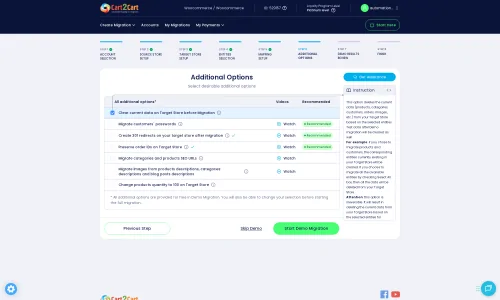
Additional Migration Options
You'll find a list of powerful options to refine your migration. Consider the following:
- Clear Target Store Data: The 'Clear Target' option allows you to clear existing data on your Shopware store before migration. This is often recommended for fresh installations.
- Preserve IDs: Options like 'Preserve Customers IDs', 'Preserve Orders IDs', and 'Preserve Category IDs' are available. However, be aware that for Shopware versions 6 and above, there might be ID preservation limitations.
- Migrate Images in Description: Ensure product images embedded in descriptions are transferred.
- Create Variants from Attributes: If your Lightspeed POS CSVs contain product attributes that define variants, this option helps recreate them in Shopware.
- Password Migration: If your CSV export from Lightspeed POS includes hashed customer passwords in a compatible format, this option can be enabled. However, compatibility should be verified for successful transfer.
- SEO URLs: Preserve your search engine optimization efforts by migrating SEO-friendly URLs.
- Concat Short Description: This option can combine short descriptions to fit Shopware's fields.
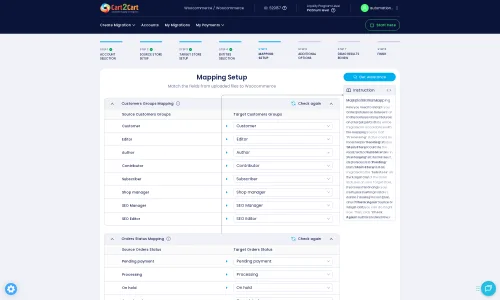
Data Mapping Setup
The mapping setup ensures that customer groups and order statuses from your Lightspeed POS data are correctly aligned with the corresponding fields in your Shopware store. This guarantees data integrity and a seamless user experience post-migration.
Carefully map:
- Customer Groups: Match customer roles (e.g., 'Wholesale' to 'B2B Customer')
- Order Statuses: Align order states (e.g., 'Pending payment' to 'Open', 'Processing' to 'In Progress')
Step 5: Run Demo Migration and Initiate Full Migration
Before committing to a full data transfer, it's highly recommended to run a free demo migration. This allows you to migrate a limited number of entities (e.g., 10-20 products, customers, and orders) to your Shopware store. Review the demo results thoroughly to ensure everything looks correct and as expected. This step helps identify and resolve any potential issues before the main event.
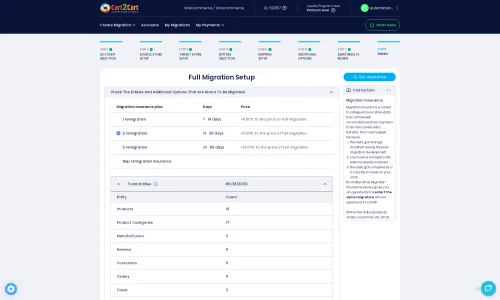
Once you're satisfied with the demo, you can proceed with the full migration. This will transfer all selected data entities from your Lightspeed POS CSV files to your new Shopware store. During this stage, you might also consider adding Migration Insurance, which offers additional remigrations for a specified period, providing peace of mind. Learn more about how Migration Insurance works.
Post-Migration Steps
Congratulations! Your data has been transferred to Shopware. However, the migration process isn't truly complete until you've performed these crucial post-migration tasks.
- Thorough Data Verification: Rigorously check your new Shopware store. Verify that all product data (SKUs, variants, prices, images, descriptions), customer accounts, order history, categories, and CMS pages have been migrated accurately and completely. Look for any broken links or missing assets.
- SEO Optimization & Redirects: Implement 301 redirects for any URLs that may have changed during the replatforming process, especially if the 'SEO URLs' option wasn't fully comprehensive. This is vital for preserving your existing SEO rankings and link equity. Update your sitemap and submit it to search engines.
- Configure Shopware: Set up essential Shopware functionalities that weren't part of the data transfer. This includes configuring payment gateways, shipping methods, tax rules (Shopware supports multi-tax), currency settings, and any required security settings.
- Theme Customization and Design: Customize your Shopware theme to match your brand's aesthetic and ensure a compelling user experience.
- Install and Configure New Plugins: Install any necessary Shopware plugins or extensions to replicate functionality from your Lightspeed POS setup or to add new features.
- Extensive Testing: Conduct comprehensive tests of your new store's functionality. This includes placing test orders, creating customer accounts, checking search functionality, validating contact forms, and ensuring mobile responsiveness.
- Go Live: Once you're confident that your Shopware store is fully functional and all data is correct, update your DNS settings to point to your new Shopware store.
- Ongoing Monitoring: After going live, continuously monitor your site's performance, traffic, conversions, and error logs to quickly address any unforeseen issues. Consider using our Recent Data Migration Service to capture any new customer or order data that might have occurred on your Lightspeed POS system between your initial export and your Shopware go-live.
By following these steps, you can ensure a successful and seamless transition from Lightspeed POS to Shopware, setting your e-commerce business up for future growth and success.
Ways to perform migration from Lightspeed POS to Shopware
Automated migration
Just set up the migration and choose the entities to move – the service will do the rest.
Try It Free
Data Migration Service Package
Delegate the job to the highly-skilled migration experts and get the job done.
Choose Package

Benefits for Store Owners

Benefits for Ecommerce Agencies
Choose all the extra migration options and get 40% off their total Price

The design and store functionality transfer is impossible due to Lightspeed POS to Shopware limitations. However, you can recreate it with the help of a 3rd-party developer.

Your data is safely locked with Cart2Cart
We built in many security measures so you can safely migrate from Lightspeed POS to Shopware. Check out our Security Policy
Server Security
All migrations are performed on a secure dedicated Hetzner server with restricted physical access.Application Security
HTTPS protocol and 128-bit SSL encryption are used to protect the data being exchanged.Network Security
The most up-to-date network architecture schema, firewall and access restrictions protect our system from electronic attacks.Data Access Control
Employee access to customer migration data is restricted, logged and audited.Frequently Asked Questions
How can I protect my SEO rankings when migrating from Lightspeed POS to Shopware?
Will my Lightspeed POS store's design and theme automatically transfer to Shopware?
Can customer passwords be transferred from Lightspeed POS to Shopware?
What is the typical timeline for a Lightspeed POS to Shopware migration?
Which data entities can be migrated from Lightspeed POS to Shopware?
Will my Lightspeed POS store go offline during migration to Shopware?
Should I use an automated tool or hire an expert for Lightspeed POS to Shopware migration?
How can I validate data accuracy after my Lightspeed POS to Shopware migration?
Is my Lightspeed POS store's data secure during the transition to Shopware?
What are the cost factors for migrating from Lightspeed POS to Shopware?
Why 150.000+ customers all over the globe have chosen Cart2Cart?
100% non-techie friendly
Cart2Cart is recommended by Shopify, WooCommerce, Wix, OpenCart, PrestaShop and other top ecommerce platforms.
Keep selling while migrating
The process of data transfer has no effect on the migrated store. At all.
24/7 live support
Get every bit of help right when you need it. Our live chat experts will eagerly guide you through the entire migration process.
Lightning fast migration
Just a few hours - and all your store data is moved to its new home.
Open to the customers’ needs
We’re ready to help import data from database dump, csv. file, a rare shopping cart etc.
Recommended by industry leaders
Cart2Cart is recommended by Shopify, WooCommerce, Wix, OpenCart, PrestaShop and other top ecommerce platforms.
Trusted by eCommerce dominators since 2009















Really great service. We migrated an old Gambio shop to Shopware. The Shopware internal tool was not compatible to that Gambio version so we needed another tool to migrate products and customer data. The support of cart2cart was very nice and helped us with some issues we had with that old Gambio Version.
We will use the service of cart2cart in futures projects too!
Review source
Migrated from an old magento version to shopware. We had some custom issues concerning article variants, prices, images and so on. The support team was always very fast and capable. They did a great job on the adjustments. We definitely recommend Cart2Cart as a migration service!
Review source

Great Solution! Excellent Support team which helped to migrate my store data from Magento to Bigcommerce in no time. Cart2Cart developed a custom solution to which helped me to Migrate my Blog Data too. I will surely use their service on my upcoming projects.
Review source

Migration from Shopify to BigCommerce was exactly what I need it. Customers information, orders, products description and images were displayed in my new platform perfectly. Additionally, the support team were very helpful and patience while I was doing all of this process. I highly recommend it!
Review source

Working with Cart2Cart on a recent Yahoo Store to BigCommerce Store migration was a pleasure. The support was very helpful in getting to my end solution. I would definitely recommend their service for anyone looking to migrate data between these platforms.
Review source

Solid work on the cart2cart migration from Magento to BigCommerce! Also, they helped me a lot for the data re-migration due to an accidental deletion on BigCommerce I definitely would recommend Cart2Cart 🙂
Review source
I have been very happy with the service and support of Cart2Cart in migrating from an older WebAsyst based e-commerce site to a much more modern CS-Cart based one. Worked perfectly!
Review source
Very good support. They migrated our store from Big Cartel to Magento, and were very cooperative during all this process. Thank you team. I recommend them to everyone
Review source
I have successfully used Cart2Cart to migrate products & categories from DrupalCommerce to Magento. It’s easy, affordable and they offer decent support (no I’m not affiliated with them).
Review source
we have already contracted the service three times to migrate from prestashop to magento. We were very well catered for. I recommend!
Review source