


ShopOS to WooCommerce Migration - Step-by-Step Guide & Expert Services
ShopOS to WooCommerce migration shouldn't be daunting. Planning to move ShopOS store to WooCommerce? We simplify your switch from ShopOS to WooCommerce, ensuring a fast, secure, and seamless transfer data process with zero downtime. Preserve your valuable SEO rankings effortlessly. Whether you need a comprehensive step-by-step guide to do it yourself or require expert assistance for a done-for-you solution, we’re here to facilitate your successful ShopOS to WooCommerce migration. Start your journey with confidence.
What data can be
migrated from ShopOS to WooCommerce
-
Products
-
Product Categories
-
Manufacturers
-
Customers
-
Orders
- Name, SKU, Short Description, Full Description, Manufacturer , Tax Class, Sort Order.
- Meta Title, Meta Keywords, Meta Description.
- Quantity, Stock Availability.
- Weight, Width, Height.
- Related Products.
- Options(Name, Price).
- Name, Status.
- Meta Title, Meta Description, Meta Keywords.
- Name.
- Customer Billing Address.
- Customer Shipping Address.
- ID, Order Date, Order Status, Order Products(Name, SKU), SubTotal Price, Discount Price, Tax Price, Shipping Price, Total Price.
- Customer Name, Email, Billing Address.
- Shipping Address.
- Name, SKU, Short Description, Full Description, Manufacturer , Tax Class, Sort Order.
- Meta Title, Meta Keywords, Meta Description.
- Quantity, Stock Availability.
- Weight, Width, Height.
- Related Products.
- Options(Name, Price).
- Name, Status.
- Meta Title, Meta Description, Meta Keywords.
- Name.
- Customer Billing Address.
- Customer Shipping Address.
- ID, Order Date, Order Status, Order Products(Name, SKU), SubTotal Price, Discount Price, Tax Price, Shipping Price, Total Price.
- Customer Name, Email, Billing Address.
- Shipping Address.
Products
Estimate your Migration Cost
To check your ShopOS to WooCommerce migration price, click the button below. The migration price varies in accordance with the number of data types and the additional migration options selected.
How to Migrate from ShopOS to WooCommerce In 3 Steps?
Connect your Source & Target carts
Choose ShopOS and WooCommerce from the drop-down lists & provide the stores’ URLs in the corresponding fields.
Select the data to migrate & extra options
Choose the data you want to migrate to WooCommerce and extra options to customise your ShopOS to WooCommerce migration.
Launch your Demo/Full migration
Run a free Demo to see how the Cart2Cart service works, and when happy - launch Full migration.
Migrate ShopOS to WooCommerce: Your Definitive Guide to a Seamless Transition
A Comprehensive Guide to Transitioning from ShopOS to WooCommerce
Embarking on an e-commerce platform migration can feel like a daunting task, but moving your store from ShopOS to WooCommerce can unlock unparalleled flexibility, a vast plugin ecosystem, and robust scalability for your business. WooCommerce, built on WordPress, empowers merchants with extensive customization options, powerful SEO capabilities, and a vibrant community.
This expert guide is designed to provide you with a clear, step-by-step roadmap for migrating your valuable store data from ShopOS to WooCommerce. Since ShopOS does not offer direct API integration for third-party migration tools, we will outline the process using a CSV file export from ShopOS as your source data, and then import it efficiently into your new WooCommerce store.
Prerequisites for a Successful Migration
Before you begin the data transfer, careful preparation of both your existing ShopOS store and your new WooCommerce environment is crucial to ensure data integrity and a smooth transition. Consider these essential steps:
For Your ShopOS Store (Source):
- Data Export: Your primary task will be to export all critical data from your ShopOS store into well-structured CSV files. This includes products (with SKUs, variants, descriptions, images), product categories, customer records, orders, reviews, and any other relevant information. Ensure all fields are accurately represented in your export.
- Data Audit: Review your exported CSV files for completeness and consistency. Clean up any outdated or erroneous data to prevent issues in your new WooCommerce store.
For more detailed preparation guidelines, consult our FAQ on preparing your source store.
For Your WooCommerce Store (Target):
- WordPress & WooCommerce Installation: Ensure you have a fresh installation of WordPress and the WooCommerce plugin activated on your hosting.
- Hosting Environment: Verify that your hosting meets WooCommerce's recommended specifications for optimal performance, especially if you anticipate migrating 10,000+ products, which can affect performance.
- Theme Selection: Choose and install your desired WooCommerce theme. While data migration doesn't directly handle design, having your theme ready provides a better context for post-migration adjustments.
- Essential Plugins: WooCommerce offers core functionality, but for specific features like manufacturers, custom order statuses, or advanced customer groups, you might need additional plugins. Plan to install these after the migration.
- Cart2Cart WooCommerce Universal Migration Plugin: For seamless data connection, the Cart2Cart WooCommerce Universal Migration plugin is required for your target WooCommerce store. Install this plugin via your WordPress admin.
For additional details on setting up your new platform, refer to our guide on preparing your target store.
Performing the Migration: A Step-by-Step Guide
Once your preparation is complete, you can begin the data transfer using the migration wizard. Here’s how to navigate the process:
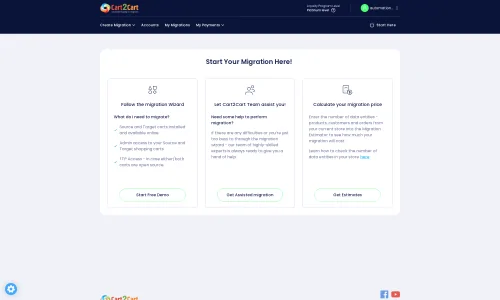
Step 1: Initiate Your Migration
Start by accessing the migration tool. You'll be presented with options to start a do-it-yourself migration, request a guided service, or calculate the cost.
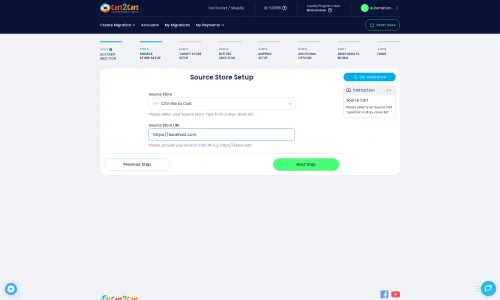
Step 2: Connect Your Source Store (ShopOS via CSV)
In the migration wizard, you will select your source platform. Since ShopOS data is prepared as CSV files, choose "CSV File to Cart" as your Source Cart. You will then upload your exported CSV files containing your products, customer data, orders, and other entities.
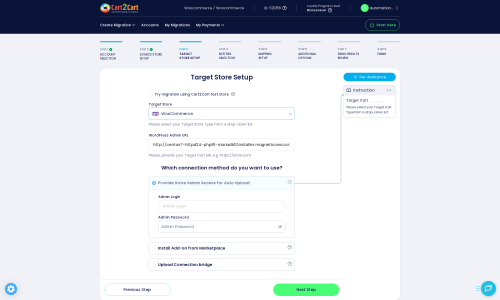
Step 3: Connect Your Target Store (WooCommerce)
Next, select "WooCommerce" as your Target Cart. Provide your WordPress Admin URL. To establish a secure data link, you'll need to grant access. The system may offer several connection methods: providing API access credentials (Consumer Key and Consumer Secret), giving store admin access for an automatic bridge upload, or manually uploading a Connection Bridge file to your store's root directory via FTP.
We generally recommend using API credentials or the automatic bridge upload for simplicity. Remember, the Cart2Cart WooCommerce Universal Migration plugin must be installed on your WooCommerce store for this connection.
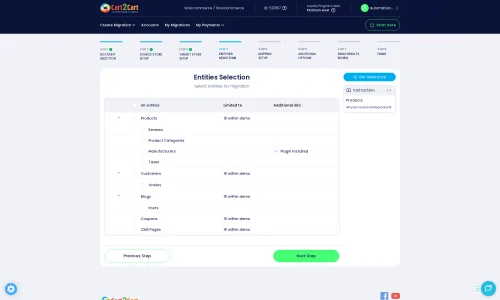
Step 4: Select Data Entities for Migration
This crucial step allows you to choose exactly which data types, or entities, you wish to transfer. You can select all available entities with a single click or manually pick specific items such as:
- Products (including SKUs, variants, images)
- Product Categories
- Customers
- Orders
- Products Reviews
- CMS Pages
- Coupons
- Blogs
- Blog Posts
Carefully review your selections to ensure all necessary business data is included in the transfer.
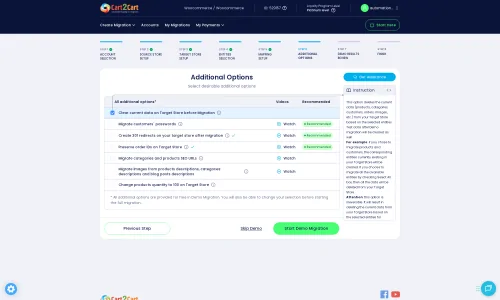
Step 5: Configure Additional Migration Options
The wizard provides various additional options to refine your data transfer. These settings are vital for preserving SEO rankings, maintaining data integrity, and optimizing the user experience on your new platform:
- Preserve IDs: Options to preserve original Category, Product, Customer, and Order IDs. This is highly recommended for consistent database management.
- Migrate Images in Description: Ensures product images embedded within descriptions are transferred.
- Password Migration: Allows existing customer passwords to be migrated, enabling a seamless login experience for your returning customers.
- SEO URLs / Create 301 SEO URLs: Absolutely critical for maintaining your SEO rankings and link equity. This creates redirects from your old ShopOS URLs to the new WooCommerce ones.
- Clear Target Store Data: The "Clear current data on Target store before migration" option is useful for fresh migrations, removing any dummy data you might have on your WooCommerce store.
Review these options carefully and select those that align with your migration strategy.
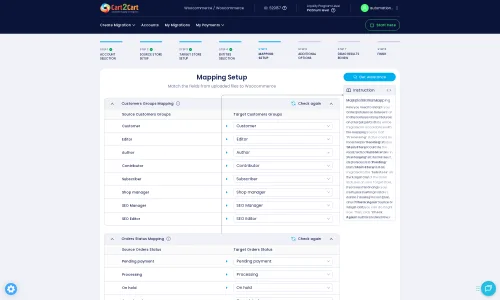
Step 6: Map Data Fields
Data mapping is an essential step to ensure customer groups, order statuses, and other custom fields from your ShopOS store are correctly matched with their equivalents in WooCommerce. This process guarantees data consistency and prevents loss of crucial business logic.
Step 7: Run a Free Demo Migration
Before committing to the full data transfer, run a free demo migration. This allows you to transfer a limited number of entities (e.g., 10 products, 10 customers, 10 orders) to your WooCommerce store. Use this opportunity to:
- Review the migrated data for accuracy.
- Check image transfers and product variants.
- Verify customer accounts and order details.
A demo helps identify and resolve potential issues before the complete migration, saving you time and effort.
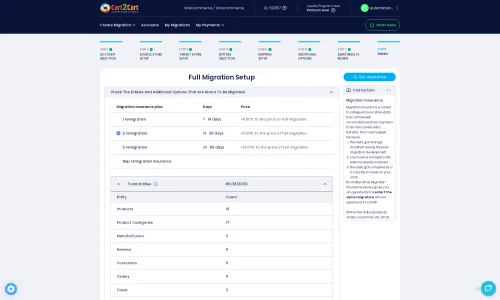
Step 8: Perform Full Data Migration
Once you are satisfied with the demo results, proceed with the full data migration. This will transfer all selected data from your ShopOS CSV files to your WooCommerce store. At this stage, you might also consider adding a Migration Insurance Plan, which offers additional remigrations for a set period, providing peace of mind.
Post-Migration Steps: Ensuring a Flawless Launch
The migration doesn't end when the data transfer is complete. A few critical post-migration tasks are necessary to ensure your new WooCommerce store is fully functional, optimized, and ready for customers:
- Verify Data Integrity: Thoroughly check all migrated data in your WooCommerce store. Confirm that products, product categories, customer records, orders, and images are all present and displayed correctly. Pay close attention to SKUs, variants, prices, and inventory levels.
- Configure SEO & Redirects: If you opted to create 301 SEO URLs during migration, verify that they are functioning correctly by testing old ShopOS URLs. Update your sitemap in Google Search Console and monitor for any crawl errors. Maintaining link equity is crucial for your SEO rankings.
- Install Essential Plugins & Extensions: Install any additional plugins required for functionality not natively supported by WooCommerce (e.g., specific payment gateways, shipping providers, ERP integrations, or plugins to manage manufacturers or custom order statuses).
- Test Store Functionality: Conduct comprehensive testing of your new WooCommerce store. This includes placing test orders, checking all payment gateways, verifying shipping calculations, reviewing customer account creation and login, and testing all forms and interactive elements.
- Update DNS Settings: Once you are confident that your WooCommerce store is fully operational and verified, update your DNS settings to point your domain name to the new WooCommerce hosting. Be prepared for a short period of propagation.
- Review User Experience (UX): Navigate your new store as if you were a customer. Check responsiveness on various devices, browser compatibility, and overall user flow to ensure a seamless shopping experience.
- Consider Recent Data Migration: If your ShopOS store remained active during the migration process, consider using a Recent Data Migration service to transfer any new data (orders, customers, products) that accumulated since your initial transfer. This ensures your new store is completely up-to-date.
Migrating from ShopOS to WooCommerce is a strategic move that positions your business for growth. By following this detailed guide and leveraging the capabilities of a specialized migration tool, you can achieve a seamless transition with minimal downtime and maximum data integrity. If you encounter any challenges or require expert assistance, remember that professional migration services are available to support you through every step of this journey. For any questions, please refer to our Frequently Asked Questions or Contact Us directly.
Ways to perform migration from ShopOS to WooCommerce
Automated migration
Just set up the migration and choose the entities to move – the service will do the rest.
Try It Free
Data Migration Service Package
Delegate the job to the highly-skilled migration experts and get the job done.
Choose Package
Custom Migration
Need metafields, SEO URLs, variant rules, or other tailored mapping? Explore customizations built for real merchant demand.
Browse Customizations

Benefits for Store Owners

Benefits for Ecommerce Agencies
Choose all the extra migration options and get 40% off their total Price

The design and store functionality transfer is impossible due to ShopOS to WooCommerce limitations. However, you can recreate it with the help of a 3rd-party developer.

Your data is safely locked with Cart2Cart
We built in many security measures so you can safely migrate from ShopOS to WooCommerce. Check out our Security Policy
Server Security
All migrations are performed on a secure dedicated Hetzner server with restricted physical access.Application Security
HTTPS protocol and 128-bit SSL encryption are used to protect the data being exchanged.Network Security
The most up-to-date network architecture schema, firewall and access restrictions protect our system from electronic attacks.Data Access Control
Employee access to customer migration data is restricted, logged and audited.Frequently Asked Questions
Is my ShopOS data secure during the transfer to WooCommerce?
Will my ShopOS store experience downtime during migration to WooCommerce?
What is the estimated timeline for ShopOS to WooCommerce migration?
Which data entities can be migrated from ShopOS to WooCommerce?
How can I preserve SEO rankings when migrating from ShopOS to WooCommerce?
What factors determine the cost of ShopOS to WooCommerce migration?
Will customer passwords be migrated from ShopOS to WooCommerce?
Can my ShopOS store's design and theme be transferred to WooCommerce?
Should I use an automated tool or hire an expert for ShopOS to WooCommerce migration?
How to ensure data accuracy after migrating from ShopOS to WooCommerce?
Why 150.000+ customers all over the globe have chosen Cart2Cart?
100% non-techie friendly
Cart2Cart is recommended by Shopify, WooCommerce, Wix, OpenCart, PrestaShop and other top ecommerce platforms.
Keep selling while migrating
The process of data transfer has no effect on the migrated store. At all.
24/7 live support
Get every bit of help right when you need it. Our live chat experts will eagerly guide you through the entire migration process.
Lightning fast migration
Just a few hours - and all your store data is moved to its new home.
Open to the customers’ needs
We’re ready to help import data from database dump, csv. file, a rare shopping cart etc.
Recommended by industry leaders
Cart2Cart is recommended by Shopify, WooCommerce, Wix, OpenCart, PrestaShop and other top ecommerce platforms.
Trusted by eCommerce dominators since 2009











So now I have a perfect copy of my Shopify store on my Woocommerce platform. All within 2 days and I didn’t have to code anything – the migration took just a few clicks – fully automated. Ok, that’s it I just like when I see somebody really care about your business so I felt like I’d let the world know about my experience with this company
Review source
My migration from BigCommerce to WooCommerce was so easy, so time-saving, and so successful that I can’t believe all that work was done with one click!
Thanks to Cart2Cart for a fantastic service. Totally recommended!
Review source
I had a lot of pre-sales questions about the plugin and the migration. The service provided was absolutely perfect, quick and in-depth responses. My final migration has just finished and it did so in 27 minutes to be precise. If you are looking for the perfect, headache-free tool for your (in my case Magento to Woocommerce) migration, look no further, THIS IS IT! For those who expected such a plugin to be for free, are you kidding me?!?!
Review source
I’ve used the service/software for two website migrations (ZenCart to WooCommerce). The second one failed, also because of my own error, but the supprt was great and Cart2Cart team helped getting it all working flawless.
Very impressed by this software and even more by the aftersales support. Will use again when needed.
Review source
I moved a site from Jigoshop Version 2 (the jigoshop upgrade from v1 to v2 was poor) to WooCommerce and I am very happy with the results. My original Jigoshop site had been hacked so it wasn’t ideal, but Cart to Cart were very helpful and their support was very good. 🙂
Review source
Excellent Support for the non expert who needs a lot of assistance they spent as much time as I needed to insure I got my migration. The upload went well after the Demo. Customer service was there when I had questions or issues to fine tune after purchase. I would recommend if you need to import / migrate your Products from Shopify to Woocommerce in Word Press as I did.
Review source
Company went above and beyond to handle the migration, even doing 2 additional trials to get it right.
The project was involved as it had a large product count, user count, and orders going back 5 years. This involved doing the CMS and Shopping cart migration from Drupal / Ubercart to WordPress / Woocommerce.
I had the new site up the same day as the migration and only had to do some fine tuning, menus setup, and correct some links.
Pleasure to have a second migration done with this company.
Review source
Tried to do the data migration myself and failed even after spending so many hours attempting different things. With Cart2Cart the data import from 3dcart to WooCommerce was quick and easy. Support response time was great and replies were really helpful. Definitely worth the cost and it saved me many more headaches
Review source
I needed to migrate a lot of product data (title, price, description, images) from an old Mojishop installation on Joomla to a new shop system based on Woocommerce on WordPress. The setup was very easy (you need FTP access on your webspace).
Before you pay for the great service you can make several test migrations. It turned out there were some product information missing on the new system, because my data base had a custom name. I did not find out this by my own.
So I contacted the customer support of Cart2Cart. I got immediately help and two days later a custom solution for my problem.
This is a service! Thanks a lot.
Review source